Can International Students Work While Studying in India? (2026)
Authored by Priya Sharma, Senior International Admissions Advisor | Most recent update: June 15, 2026

Can International Students Work in India? The Short Answer
Curious if foreign students are allowed to work in India with a student visa? The brief response is generally not. With the S-1 student visa, off-campus part-time employment is forbidden (IDP). You may only engage in tasks related to your course. This indicates internships, jobs on campus, and research or teaching assistant positions recognized by your institution (Careers360). India’s regulations contrast significantly with those of other study locations. The table below displays the work permissions for comparison.
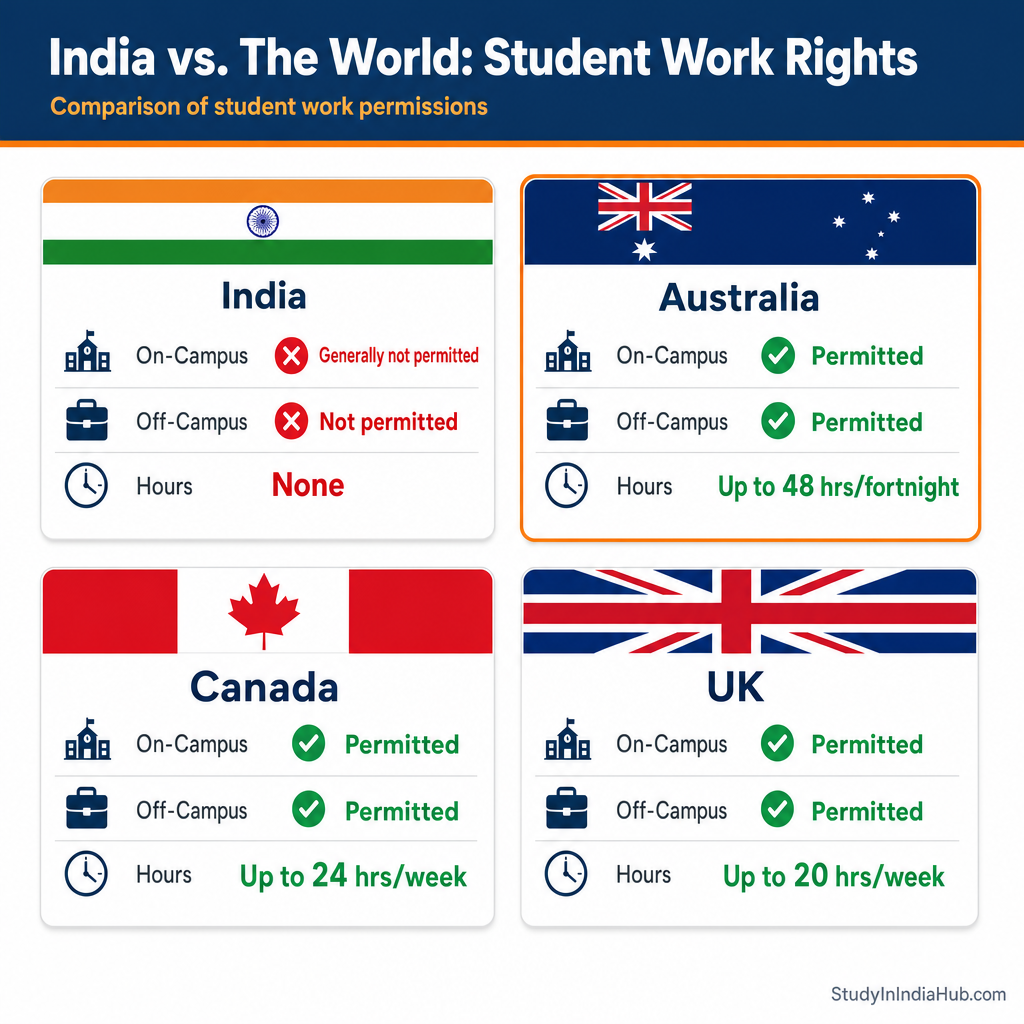
| Country | On-Campus Work | Off-Campus Work | Hours During Term |
|---|---|---|---|
| India | Generally not permitted | Not permitted | None (study-only visa) |
| Australia | Permitted | Permitted | Up to 48 hours per fortnight |
| Canada | Permitted | Permitted | Up to 24 hours per week |
| UK | Permitted | Permitted | Up to 20 hours per week |
In contrast to Australia, Canada, and the UK, India's student visa does not include any work rights. Therefore, avoid basing your plans on part-time earnings. Regularly verify the latest regulations with the Bureau of Immigration and your educational institution. Visa requirements may vary. You will find an "up to 20 hours each week" number on the internet (DNA India). It probably originates from other nations, where students may work 20 or 24 hours weekly while enrolled (immitalks.com). Handle it with care. It is not a reliable guideline for India. The exam is straightforward. If the task isn't connected to your course, department, or an authorized campus position, don't presume it's permitted. A university approval letter is required that aligns with your visa conditions (India Consulate NY).
What the Student Visa Actually Allows
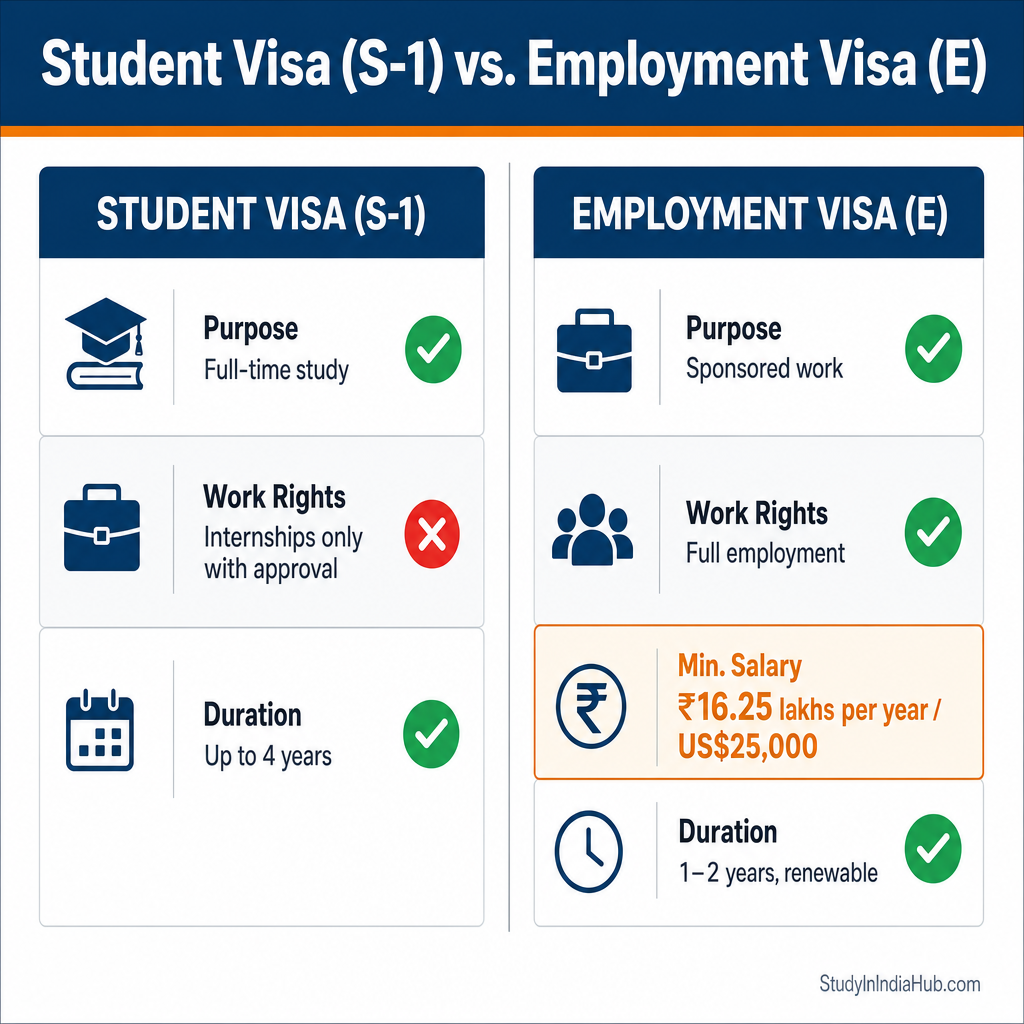
Your student visa has one strict regulation. You are prohibited from engaging in general employment in India (Bureau of Immigration). All else rests upon that base. I've guided students through this numerous times. The misunderstanding often begins at this point. They believe a "student visa" functions similarly to a work visa. It does not. The S-1 student visa is distinct in legal terms from an Employment (E) visa. By applying, you inform the government that you intend to study rather than work. The visa regulations explicitly state that work is not permitted. Internships require approval from the university (Indian Visa Online, Bureau of Immigration). Accept a typical job, whether part-time or freelance, and you face the threat of deportation. There is also the possibility of being blacklisted on the e-FRRO portal and complications for your university's international student status (studyinindia.gov.in). I previously assisted a Nepali student whose roommate accepted a freelance job without informing anyone. During a standard FRRO check, it identified the whole group. The university needed to submit clarifications. It could have been avoided.
Student Visa vs. Employment Visa
| Feature | Student Visa (S-1) | Employment Visa (E) |
|---|---|---|
| Purpose | Full-time study | Sponsored work |
| Work rights | Internships only (with approval) | Full employment |
| Min. gross salary | N/A | ₹16.25 lakhs per year (Gloroots) |
| Duration | Up to 4 years (UG) (IDP) | 1–2 years, renewable |
Wondering, "Is it possible to change my path once I finish school?" You are able to. However, only if a sponsoring employer provides a position that meets the ₹16.25 LPA threshold set by the Ministry of Home Affairs (Bureau of Immigration). In reality, that hinders numerous entry-level opportunities. I assisted a student with a Mumbai offer that was declined due to the salary being below this threshold. You require three items to obtain the visa ([Indian Visa Online]):- Evidence of enrollment at a recognized Indian educational institution- Scholarly transcripts- Proof of financial support
Processing averages 2–8 weeks by country and season.
Examine the precise text on your visa page as soon as your passport is returned. If it states "no employment," that is conclusive. If it states "internships sanctioned by the university," that’s your path. Avoid making assumptions.
Work That Is Permitted: Internships, Assistantships and On-Campus Roles
The valid employment choices have a common principle. The project needs to connect to your university, be recorded in writing, and be in the files prior to your commencement. Here’s what is truly available to you.
Curriculum-Linked Internships
The only acceptable internships are those that are part of your academic program. A university approval letter is required prior to starting (India Consulate NY). It is listed in your course handbook. It is included in your syllabus. Your department sends a formal letter affirming it's essential to your program. The internship needs to be with an organization based in India. Your university facilitates communication between the employer and your FRRO office. A BTech in Computer Science can take on an internship in software development. A retail position doesn't count, not even on a part-time basis. If your course does not include a practical element, the Bureau of Immigration considers employment outside as a visa infringement (Bureau of Immigration). Here’s what we observe goes awry. A student considers a laid-back summer job as "experience." However, the institute never documented the approval. A Nepali student's internship at a research institute was postponed by three weeks due to the university's failure to deliver the approval letter to FRRO. Therefore, verify initially. Does your university utilize an official procedure for internship approvals? The majority does. SPPU operates a specialized International Centre that manages these letters (SPPU International Centre).Is payment possible? Yes, however, details on payment limits are not disclosed publicly. Obtain the approval letter initially, next talk about compensation. The request is straightforward:1. Verify with your department head that the internship is applicable for your degree.2. Obtain an official approval letter from the placement cell or international office at your university.3. Present it to your employer, businesses frequently request this NOC prior to your commencement.4. Maintain a copy for your FRRO recordsMedical and paramedical students must obtain an NOC from the Ministry of Health (Study in India). Always send emails using the ID associated with your Study in India Portal. I've witnessed an internship get canceled due to a personal Gmail disrupting the data trail. Your visa remains valid for the length of the course or 5 years, whichever is shorter. The internship is not extended.
Research and Teaching Assistantships
Your university is able to hire you directly. This includes teaching assistant roles, research assistant roles, or library assistance. It’s the most straightforward route since the organization manages compliance. The department determines the role, drafts a letter verifying its inclusion in your program, and files it with your FRRO documentation. For a PhD or master's research program, this typically is included in your funding package. It’s included in your admission offer, not an additional job you seek afterwards.
Permissions depend on your programme level:
| Programme level | Hours allowed | Notes |
|---|---|---|
| Masters by Research / PhD | Unlimited | Best fit for research-linked roles (IDP) |
| Undergraduate / taught postgraduate | 25 hrs/week in term, 40 hrs/week in holidays | Must be documented before you start (IDP) |
The position typically includes responsibilities related to research or teaching associated with your program. The allowance includes essential expenses such as accommodation, meals, and regional transportation. The payment route is determined by the university or scholarship organization. ICCR shifted scholarship payments to PFMS starting from February 2021. For students with scholarships, the financial pathway connects to a legitimate government payment system. Nepali students may apply via the A2A portal for undergraduate, postgraduate, and doctoral programmes (Study in India). Obtain the letter from your department chair or international office prior to your first day. Verify a couple of aspects before depending on it:1. Is the position officially approved in writing (through a departmental letter or scholarship approval letter)?2. Is payment referenced in that letter?3. Are your details consistent between your passport, admission letter, and PFMS record? The final point is important. The identical name-mismatch issue that postpones FRRO registration can hinder assistantship documentation (e-FRRO Portal). First, arrange your banking and FRRO procedures. The department enrolls you in payroll during your initial week.
Research Roles and Lab Work
In a research-oriented program, such as a Masters by Research, PhD, or certain undergraduate honors pathways, your university may assign you to a lab or research facility. It’s scholarly work, not a job. PhD and Research Masters students receive unlimited hours. A letter from your supervisor verifying the position and hours will be required. Undergraduate and taught postgraduate students engaged in research assistantships adhere to the 25-hour term limit, allowing for some flexibility during breaks.
What You Cannot Do
You are unable to work outside your university or an authorized internship. No jobs in cafés or retail. No independent work for outside or overseas businesses. No freelance work. Students attempting these pathways encountered visa cancellations or issues with the FRRO.
Documentation You'll Need
Prior to accepting any position, request a letter on university letterhead from your international office that includes:- Your name, passport ID, and visa information- The job position and department/organization- Anticipated weekly hours and timeframe- Verification that the position is included in your academic curriculum.- Signature from your department chair or director of the international officeRetain this with your visa paperwork. During FRRO renewal or any inquiries, it serves as your evidence that the work is valid.
 Are you still selecting a university? Support systems differ significantly. SPPU's International Centre openly provides assistance with admissions, FRRO support, hostel distribution, and health insurance (SPPU International Centre). The Office of International Relations at IIT Bombay performs similar functions (IIT Bombay IR). That stream of paperwork is how students learn about sanctioned campus positions.
Permissions and Documentation You Need
In addition to the role-specific documents, there are three levels of paperwork to complete. Complete this prior to accepting any internship, research assistantship, or campus position. Pupils who miss a stage find themselves hindered. Either their work is marked as unauthorized, or they are unable to demonstrate they had permission afterwards.
Step 1: Get University Clearance
The specific role must be approved by your university. This is not an automatic approval. The international office or department evaluates the job description, the working hours, and if it complies with your visa requirements. At SPPU, this requires 3–5 business days after you provide the offer letter along with a short role description. At Mumbai University, it is managed at the departmental level. Reach out directly to the international student liaison in your department. A letter of approval in writing on official university letterhead is required. Maintain it. You will require it for FRRO registration and as evidence if your employer asks at any time.
Step 2: Register with FRRO Within 14 Days
Upon arriving in India, you must register with the Foreigners Regional Registration Office (FRRO) or Foreigners Registration Office (FRO) within 14 days (MEA India). The procedure is currently available online:- Set up account → Request Registration → Upload files → Send- Processing occurs within 24 hours, and no office visit is required unless you receive a call (e-FRRO Portal)- Submit your passport (initial and final four pages), visa page, admission letter, and university approval letter. I assisted a Nepali student whose FRRO registration was postponed by 3 weeks. The name on her passport did not align with her enrollment record. One had a middle name, the other lacked one. Verify the spelling, passport number, and course title initially. Inconsistent documentation is the primary reason for student visa issues (Y-Axis).Nepali students: despite having open-border access, FRRO registration is still necessary for studies exceeding 180 days. Starting from 2025–26, this will pertain to all Nepali students enrolled in full-time programs (e-FRRO Portal).
Step 3: Verify Visa Conditions and NOC
Your student visa (S-1) contains particular conditions inscribed on it. Certain internships are allowed that are linked to your studies. Some do not. If your visa does not mention work, reach out to the FRRO/FRO for your city before you begin (e-FRRO Portal). Certain employers additionally require a No Objection Certificate (NOC). It's uncommon for internships, but inquire in advance. The international office at your university can provide one, typically in 2–3 days.
The order I use with students:
- First, obtain university clearance2. NOC, if needed3. FRRO registration must occur within 14 days4. Agree to the position solely after confirming your visa requirements.
Taxes, Earnings Limits and Compliance Risks
As soon as you start making money, the regulations become strict. Here’s what truly occurs when you obtain money in India while on a student visa.All income you earn in India is subject to taxation. Whether it’s a research stipend, a salary from on-campus employment, or an honorarium for teaching support, each is liable for income tax. You will submit returns to the Income Tax Department utilizing your PAN card (Permanent Account Number). Your situation is classified under the Income Tax Act, 1961. Your slab is determined by residency status and overall earnings. Therefore, examine the guidelines before agreeing to compensated tasks. If uncertain, verify your residency status according to Section 6 with a knowledgeable tax professional. The most frequent issue observed is not obtaining a PAN prior to the initial payment. A PAN enables you to submit returns and prevent increased TDS deductions on stipends and research grants. Students with taxable income are required to submit a return by 31 July after the financial year (April–March). Retain Form 16 or stipend receipts available. Students who organize PAN early seldom experience delays in refunds or filing. Panjab University considers an individual as NRI for admission only if they satisfy the NRI status criterion as per the Income Tax Act, 1961 (Panjab University rule). Your tax classification and admission classification may be considered independently.
Is there an earnings cap?
The student visa regulations do not specify a formal earnings limit. However, this does not imply unrestricted income. Your sponsor, the university: holds compliance responsibilities, including a 95% enrollment rate (IDP India). If authorities observe you working 40 hours weekly instead of focusing on your studies, it harms your sponsor's reputation and jeopardizes your visa. The problem typically lies in compliance rather than the quantity.
What happens if you work without permission?
The penalties are not a fine and a warning.
| Situation | Safe approach | Risk if ignored |
|---|---|---|
| Paid work on the side | Verify university permission and visa conditions first | Visa cancellation |
| Internship for credit | Keep the university approval letter | Deportation |
| Any paid role | Track tax and payment records | Future entry bans |
I assisted a Nepali student who lost his visa due to undisclosed freelance translation jobs. His family dedicated months to organizing the legal aspects. He was unable to return to India for three years. After a violation is logged, the subsequent visa officer can view it.Record everything. Obtain written approval from the university prior to any paid employment and retain it with your visa paperwork. That letter serves as your evidence that the work was approved.
FAQ
Must I pay tax on earnings obtained in India?If the earnings are subject to tax, yes, verify your Income Tax Act, 1961 status (Panjab University regulation).Do students have a set limit on their earnings?There is no official limit present in the regulations. Particular information isn't accessible to the public.Is it possible for me to work first and handle the paperwork afterward?Negative. That’s the quickest method to generate a compliance record you don’t need.What is the greatest compliance risk?Operating without authorization or disregarding sponsor requirements like the 95% enrollment.
Working in India After You Graduate
India does not offer an automatic post-study work visa. To remain and work post-graduation, you need to change your Student Visa to an Employment Visa via a sponsoring employer prior to the expiration of your student status (Gloroots). The greatest obstacle is consistently the minimum wage limit. Your employment proposal must include a gross yearly salary surpassing US$25,000 (Gloroots). This is the recognized minimum for applicants of an Employment Visa (EY). If your proposal is even marginally under the rupee conversion, the FRRO will probably decline it. A student missed out on a position in Bangalore as their "Cost to Company" (CTC) had non-cash perks that the immigration office didn't recognize as part of the base salary. Therefore, verify the total amount, rather than the main CTC.
What the realistic path looks like
- Finish your degree and get at least a provisional certificate.
- Secure a job offer from a registered Indian entity willing to sponsor a foreign hire.
- Confirm the offer's gross annual salary exceeds US$25,000.
- Apply for the conversion via the e-FRRO portal with the employer's undertaking documents.
| Path after graduation | What you need | Main risk |
|---|---|---|
| Employment Visa conversion | Sponsoring employer + US$25,000+ gross annual salary (Gloroots; EY) | Offer below threshold, or employer won't sponsor |
| No conversion | Nothing automatic | Graduation alone is not permission to work (Gloroots) |
Here’s what students often overlook. Graduation does not mean visa authorization. Employment surveys such as HESA/Jisc Graduate Outcomes and Universities UK's International Graduate Outcomes 2024 monitor graduates’ activities post-study. They do not represent Indian work permits. Begin your job search a minimum of six months prior to final exams. The visa process relies solely on the offer letter and compensation details. The most straightforward instances are students who secure the employer in advance. If you fail to obtain a position that meets the US$25,000 minimum, you need to go back home or pursue a higher degree to legally prolong your stay (studyinindia.gov.in).
Practical Steps Before You Take Any Work
Prior to accepting any job, internship, assistantship, or similar opportunity: the sequence is more significant than students realize. The most frequent error is omitting the initial step. That’s the point where the issues begin. We collaborated with a Nepali student who started accepting minor online translation jobs during their initial semester. They made approximately ₹15,000 each month for about eight months. The earnings emerged during a visa renewal assessment. The outcome was a delayed extension, an official clarification to the FRRO, and weeks of doubt that almost jeopardized their academic year. The lesson is straightforward yet expensive. Even casual, remote, or low-paid freelance jobs are considered unauthorized employment unless explicitly allowed by your visa.Step 1: Verify with your university initially. Your institution has the ultimate authority. Certain organizations enforce internal policies that are more stringent than the national regulations demand. Reach out to your International Student Office prior to making any commitments. SPPU's International Centre manages FRRO assistance, work permits, health insurance, and hostel assignments for approximately 14,000 international students from over 102 countries. They’re your initial contact, not your final one.Step 2: Review your visa requirements thoroughly. Holders of student visas are not permitted to work. The sole exception is internships, which require university approval, according to the Bureau of Immigration. This constitutes a legal requirement. Breaking it makes you subject to legal action and penalties according to Indian law.Step 3: Verify MEA and MHA instructions. Examine the Ministry of External Affairs registration checklist and MHA/Study in India websites for up-to-date regulations. The Study in India platform was collaboratively initiated by the MoE, MEA, and MHA on 3 August 2023 and contains official onboarding information.Step 4: Check your FRRO status. Compare your passport, admission documents, and university records thoroughly. A single name discrepancy can postpone registration by three weeks on the e-FRRO portal.Step 5: Prioritize your studies. Your visa is granted primarily because you are a student.
What internship options exist?
Internship opportunities are categorized into three types: course-related internships, research/teaching assistant roles, and off-campus internships that require employer and FRRO approval.
Course-Tied Internships
If your program incorporates the internship into the degree, you’re in the best situation. MBBS has a 1-year internship included in the regular 5.5-year program (edmaster.co). The internship is mandatory. It's integrated into your curriculum. The international office at your university manages placement and documentation, working with hospitals, clinics, or research facilities. You do not require a distinct work authorization since it is included in your program. Numerous MBA and engineering programs incorporate internship semesters as well. Specializations in business such as Finance, Marketing, Human Resource Management, International Business, Business Analytics, and Operations Management frequently coordinate internships with academic coursework (gims.net.in). Review your course handbook prior to your arrival. If it's specified as a course element, your university directs the procedure.
Off-Campus Internships
Here is where the regulations become stricter. For an internship not required by your course, you must obtain clear approval from both your university and your FRRO. The internship must be either unpaid or offer a minimal payment, based on your visa requirements. Certain companies avoid hiring international students due to the compliance burden. Multinational companies and research organizations have accomplished it previously and act more swiftly.
What to Confirm Before You Sign
- Inquire with your international office: "Is this internship included in my course prerequisites?"2. Obtain a formal offer that includes the company name and position.3. Verify the internship aligns with your program with your department.4. Save the college's approval letter or email as a PDF along with the training schedule. The college transcript, rather than just the offer letter: safeguards you. Inquire at the start. The sooner you inquire, the sooner they reveal what's truly needed instead of just paperwork clutter.
Common Mistakes to Avoid
Misjudging the expenses of living and stretching your budget too thin. Numerous students come anticipating low living expenses all around. However, cities such as Mumbai, Delhi, and Bangalore can quickly deplete your finances. Create a practical monthly budget prior to your arrival. Monitor your rent, groceries, and transportation during the initial month to understand your actual figures.Presenting incomplete or unauthenticated documents in your application. This is a common pitfall. Indian universities frequently ask for verified copies.
Frequently Asked Questions
Is it possible for me to accept a job that doesn't connect to my studies?Typically, no. A paid position must comply with your student visa requirements and your university's regulations. If it doesn't obviously qualify, regard it as not allowed and obtain written confirmation before proceeding. We've observed students spend weeks resolving a blocked file because they believed that "minor tasks" wouldn't be significant. Store the offer letter, job description, and any emails from your department in a single folder.What happens if my internship doesn't offer payment?Just because it's unpaid doesn't mean it's permitted. FRRO and your institution are concerned about whether the internship is a component of your course and is appropriately documented. Request a bonafide certificate from your university and store it with the offer letter. We have arranged this with Mumbai University ISC multiple times.What occurs if my name on the passport differs from the university record?Resolve it right away. The identical middle-name discrepancy that postponed a Nepali student's FRRO registration by 3 weeks could disrupt your application. Have the passport, admission letter, and bonafide certificate verified next to each other prior to your appointment.Is a local address required prior to my FRRO paperwork?Affirmative. A stable address is required for your registration file. Delays occur in temporary accommodation when the hostel letter or rental agreement is inconsistent with the application. Your proof of address must indicate your actual residence.What amount should I allocate for my monthly living expenses?Budget for ₹14,500–₹37,500 monthly in a hostel or PG. A one-bedroom unit in downtown Mumbai typically costs ₹60,778 (Numbeo). That's why the majority of international students prefer campus accommodations.
| Item | Mumbai | Pune |
|---|---|---|
| On-campus hostel | ₹5,000–₹15,000 (data) | ₹4,000–₹12,000 (data) |
| PG accommodation | ₹8,000–₹20,000 | — |
| Mess plan (food) | ₹3,000–₹5,000 (Univ. of Mumbai) | — |
| Eating out | ₹6,000–₹12,000 | — |
| Transport pass | ~₹500 | — |
In what ways does India stack up against Canada or the UK regarding living expenses?
| Country | Living cost requirement |
|---|---|
| India | ~$15,000–$25,000 per year (immitalks.com) |
| Canada | Minimum CA$22,895 plus first-year tuition (idp.com) |
| UK | £1,529/month in London, £1,171 elsewhere (idp.com) |
India sits far below the Canada and UK ranges.
Where can I check the most recent regulations?Verify directly with your university's international office and the appropriate FRRO portal, not a screenshot from a group chat. Have your passport, visa page, admission letter, and bonafide certificate prepared before seeking any decision.
About the Author
Priya Sharma has assisted more than 2,000 international students with the Indian university admission and visa procedures since 2018. She began at SPPU's International Centre managing applications from over 40 countries, then moved to StudyInIndiaHub.com to provide similar assistance online. Her expertise lies in visa paperwork, FRRO registration, and admission prerequisites specific to each country.
How We Researched This Article
Every article is verified against original sources and evaluated by education experts who have firsthand experience in admitting international students. Our information is sourced from official university websites, NAAC/NIRF databases, government visa portals, Numbeo cost-of-living statistics, and direct contact with university international student offices. Daily updates on exchange rates. Weekly updates on living expenses. Data from the university examined every three months. To confirm the regulations regarding employment and study, we validated information from the Bureau of Immigration (boi.gov.in), the Ministry of Home Affairs visa guidelines, and the Study in India portal (studyinindia.gov.in). We additionally examined the FRRO/FRO registration criteria and the stipulations linked to student visas within the existing MHA framework. When official sources were unclear or silent, we highlighted the uncertainty instead of making assumptions to fill in the gaps. This article underwent its most recent fact-check in January 2026. It is advisable to verify details with your institution and the FRRO, as visa requirements may alter without prior notice.
Sources
- IDP
- Careers360
- DNA India
- immitalks.com
- India Consulate NY
- Bureau of Immigration
- Indian Visa Online
- studyinindia.gov.in
- Gloroots
- SPPU International Centre
- e-FRRO Portal
- IIT Bombay IR
- MEA India
- Y-Axis
- https://incometaxindia.gov.in/pages/acts/income-tax-act.aspx
- EY
- HESA/Jisc Graduate Outcomes
- Universities UK International Graduate Outcomes 2024
- edmaster.co
- gims.net.in
- Numbeo
- data
- Univ. of Mumbai