Accommodation Guide for International Students in India (2026)
Authored by Priya Sharma, Senior International Admissions Advisor | Most recent update: June 15, 2026

Your Housing Options at a Glance
There are three primary options available. University hostels are ideal for newcomers with limited budgets. PGs (paying guest arrangements) cater to individuals looking for a rapid move-in and meal provisions. Rental apartments are appropriate for students planning to remain for 2 or more years who desire personal space.
| Option | Best for | What to watch |
|---|---|---|
| University hostel | First-time arrivals, tighter budgets, mess support | ₹1,000–₹3,000/month or ₹40,000–₹2,50,000/year (Chanakya University); spaces fill fast |
| PG/private hostel | Quicker occupancy, furnished rooms, meals included | In Hyderabad, budget ₹4,000–₹6,000/month for food and utilities in shared housing (Wise) |
| Rental apartment | Longer stays, full privacy | Lease agreements, deposits, utilities, roommates — all on you |
Begin your hostel search immediately after receiving your admission offer. Students who apply within two weeks of acceptance secure the finest rooms. Hold off longer and you forfeit your top pick. Support from universities differs. At SPPU, the International Centre manages the assignment of hostels for international students. At University of Mumbai, services are managed at the departmental level. Do not anticipate a single main office (University of Mumbai).
Comparing University Hostels, PGs, and Apartments
University hostels provide the most secure and budget-friendly option for your first year. PGs provide the quickest temporary solution. Private apartments are a good choice if you seek privacy and can manage the paperwork and deposits. The element that confuses students isn't the space. It's the terms of the refund policy, configuration of meals, and conditions for the security deposit in the details. Many landlords that accept rent transfers require you to maintain a local bank account. As an international citizen, you typically establish an NRO (Non-Resident Ordinary) account according to RBI regulations (RBI / DNA India). You will require a valid passport, student visa, university acceptance letter, and evidence of local residence. Deliver your KYC documentation at a branch, finalize the face-to-face verification, and the account typically becomes active within a few business days. Verify the existing requirements with your bank, as certain private banks impose additional procedures for students (refer to Edu / RBI Guidelines). Opting for a hostel means that the university manages electricity, water, and frequently meals. By going private, you take care of all utility bills on your own, and you'll require the NRO account to settle them (RBI / DNA India).
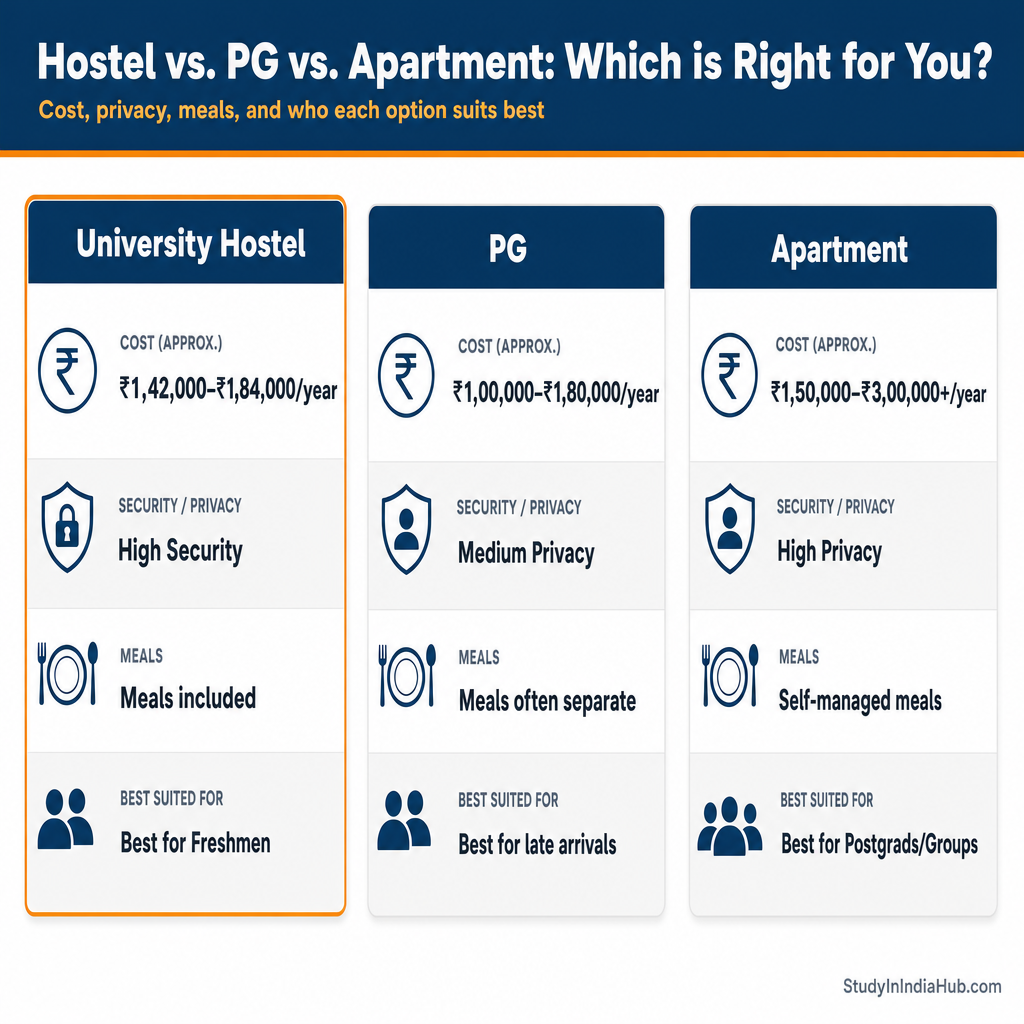
| Feature | University Hostel | Paying Guest (PG) | Private Apartment |
|---|---|---|---|
| Cost (Annual) | ₹1,42,000 (triple, food+utilities) to ₹1,84,000 (double w/ bath) at Chanakya University | ₹1,00,000 – ₹1,80,000 | ₹1,50,000 – ₹3,00,000+ |
| Privacy | Low (shared rooms) | Low to medium | High |
| Meals | Usually bundled into fee | Often separate or optional | Self-managed |
| Security | High (24/7 warden, gate control) | Varies by owner | Depends on society/landlord |
| Ease of Booking | Easiest if university allocates | Faster than apartments | Slowest (agreement + deposit) |
| Best For | Freshmen / new arrivals | Budget-conscious / late arrivals | Postgrad / roommate groups |
University Hostels
Hostels provide you with immediate address verification for your e-FRRO registration. University hostel letters generally don't lead to delays, whereas private rental contracts with name discrepancies can set you back for weeks. At SPPU, the International Centre manages hostel assignments in addition to admission and FRRO assistance. It caters to approximately 14,000 international students from over 102 countries (SPPU International Centre). Seats close to campus fill up quickly. When intake season begins, you select from what remains. The type of room alters the total quickly. Chanakya University offers a triple room for ₹1,42,000 and a double with bathroom for ₹1,84,000 (Chanakya University). Increased privacy results in a greater cost. Submit your application for on-campus housing immediately after your admission is confirmed, rather than waiting for visa approval; students who procrastinate typically find themselves in more expensive private accommodations while awaiting a campus room.
Paying Guest (PG) Accommodations
A PG serves as the intermediary. You receive a furnished bed in a supervised home with flexible dining options and a faster move-in process than an apartment. That's the reason why late arrivals frequently arrive there first. Quality varies significantly. Verify the lease contract, dining schedule, and damage deposit prior to making payment. Verify that the owner will provide you with the Form C required for filing a police report.
Private Apartments
Apartments are ideal for students with a group of roommates or for extended stays. The deposit typically ranges from 1–3 months' rent (Chanakya University). Consider it as funds you might not retrieve promptly unless the contract specifies deductions, transfer date, and utility expenses. This is a genuine dedication. Holders of student visas are not allowed to work in India (Careers360). You depend solely on your original budget. The wide yearly expense range at government universities is ₹1,20,000–2,40,000 (braingainmag.com).
The Practical Rule
- Choose a hostel for the quickest, easiest beginning if you don't mind communal living.2. Choose a PG for convenience and a quicker reservation procedure.3. Choose an apartment if you seek seclusion and can handle the security deposit, contract, and expenses. Numerous students hurry into private apartments to avoid hostel restrictions. Then they forfeit study time to landlords and expenses. If you're pursuing MBBS, your duration here is 5.5 years which includes an internship. Wait to sign a long-term lease until you've spent a semester exploring the neighborhood and your travel time. Prior to making any payment, inquire about the overall rent, meal options, inclusion of utilities, amount for the security deposit, and timeline for refunds. Those specifics determine the actual expense.
How Much Accommodation Costs by City
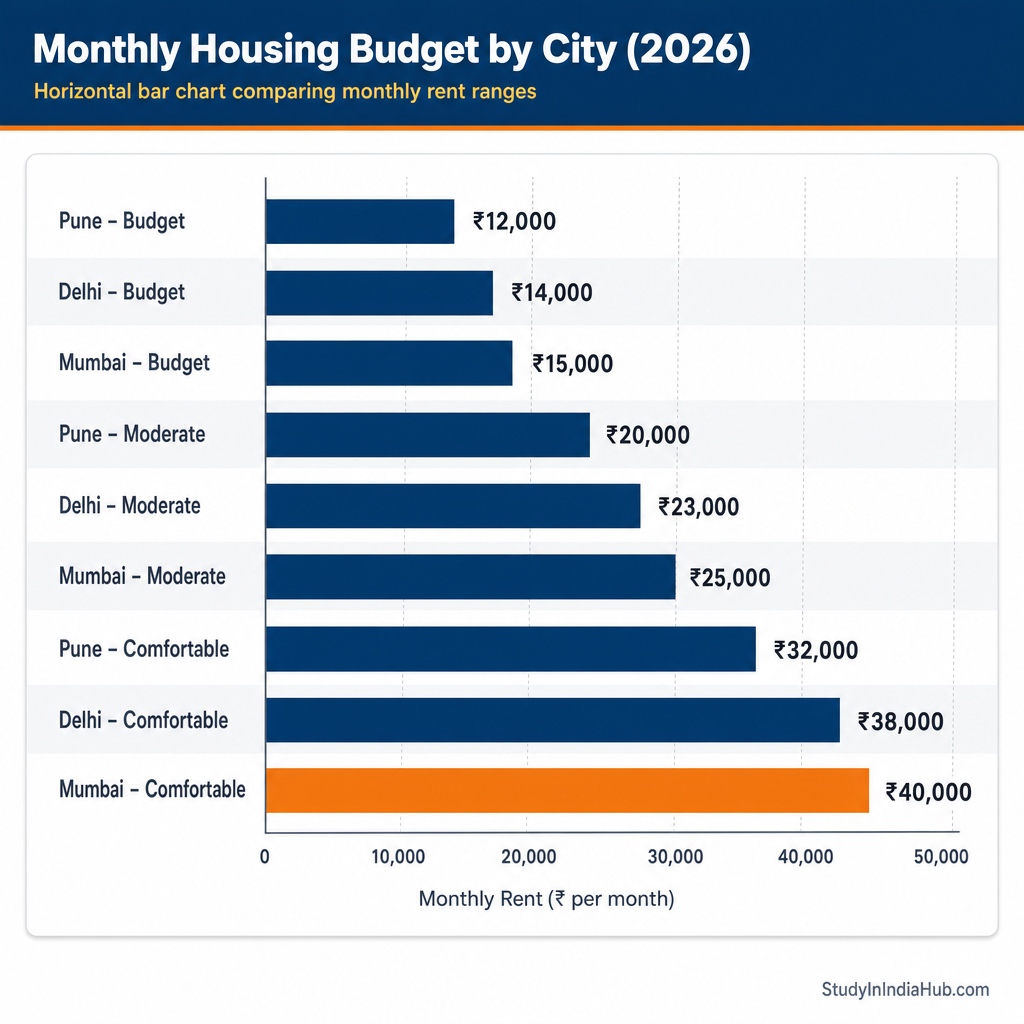
Monthly accommodation for international students in India costs ₹12,000 to ₹40,000. The difference between the most affordable and the most expensive city can reach ₹28,000 a month (Numbeo Mumbai). The level you choose influences your expenses more than the city does. Each major city provides three levels: budget (shared accommodation or simple PG), moderate (individual space in a PG or hostel), and comfortable (private apartment or high-end PG).
| City | Budget (₹/month) | Moderate (₹/month) | Comfortable (₹/month) |
|---|---|---|---|
| Mumbai | 15,000 | 25,000 | 40,000 |
| Delhi | 14,000 | 23,000 | 38,000 |
| Pune | 12,000 | 20,000 | 32,000 |
| Bengaluru | Higher than Pune, lower than Mumbai | — | — |
| Hyderabad | Comparable to Pune | — | — |
References: Numbeo Mumbai, Numbeo Delhi, Numbeo Pune, Numbeo Bangalore. Public data for Bengaluru and Hyderabad is not released in the same manner. The ranges mentioned above are derived from students we have assigned there.

Where each city lands
Mumbai is the priciest city due to the real estate shortage. Students close to NMIMS, SNDT, or Mumbai University report that being nearby increases monthly rent by ₹5,000–₹8,000. Live nearby and spend more, or live farther away and allocate it for commuting.Delhi rent typically ranges from ₹7,000 to ₹12,000 per month. Include ₹3,500–₹8,000 for meals and mess and ₹1,000–₹3,000 for transportation (Numbeo Delhi). In the budget category, you either share a room or reside off North Campus.Pune is the place where your budget goes the farthest. Housing costs are 15–20% less than in Delhi or Mumbai, with solid facilities at SPPU, Symbiosis, and Savitribai Phule (Numbeo Pune). A student from Kathmandu selected Pune instead of Mumbai and saved approximately ₹3,00,000 on accommodation during a two-year master's program.
What drives the differences
In Mumbai and Delhi, you vie with local experts for accommodation, leading landlords to set high prices. In Pune, the number of students is substantial, prompting landlords to create specialized PG facilities. This maintains competitive pricing. Being close to student centers, like North Campus in Delhi and Viman Nagar in Pune, also increases the count. Budget category does not imply inferior quality. A room costing ₹12,000–₹14,000 in Pune or Delhi typically features a tidy, furnished PG with WiFi access and a shared kitchen. The moderate level provides you with a personal room featuring a private bathroom. The cozy level is private apartment life. That's excessive for most students unless you're accompanied by family. Selecting a hostel linked to the government significantly reduces expenses. The yearly fees for 2026-27 generally range from ₹40,000 to ₹2,50,000 (Study in India). At certain public universities, they can be as low as ₹3,300 monthly (BrainGainMag).
Budget your first month separately
You'll require deposits (typically 1–2 months' rent in advance), food, SIM cards, and expenses for getting comfortable. Budget for ₹60,000–₹80,000 in the first month, and then return to your usual expenditure. The majority of international students we assist get by on ₹7–10 lakh annually in total. ICCR scholars must be aware that the A2A portal for applications for 2026–27 will be accessible from 27 February to 22 April 2026 (ICCR A2A Portal). Ensuring it alters the entire budget. Always verify the latest data with your university’s international office.
Finding Housing Near Campus in Mumbai and Pune
The neighborhoods that are most suitable rely on your university and the maximum commute time you're willing to tolerate. In each city, reside nearby enough so that registering, banking, and visiting colleges remain feasible.
Pune: Clearer Neighbourhoods, Shorter Commutes
Well-liked areas for students near SPPU are Aundh, Baner, Viman Nagar, Kothrud, Erandwane, and Shivajinagar. These regions have developed PG networks and stores that cater to the requirements of international students. The typical one-way travel duration in Pune is approximately 44 minutes for a ~16 km journey (Numbeo). Begin with the International Centre of SPPU. It manages hostel assignments, FRRO assistance, health coverage, and airport transportation from Pune Airport (PNQ) (SPPU International Centre, AAI). A student bypassed the Centre and entered a private lease with a name discrepancy. That postponed their FRRO registration by three weeks. Always ensure that your landlord will supply police-verification documents prior to making a deposit.
Mumbai: Plan Around the Commute First
Mumbai's marketplace operates at a quicker pace and has higher expenses. For Mumbai University's Fort campus, consider Colaba or Marine Drive (costly). For the Kalina campus, Santacruz and Kurla are more feasible. Vile Parle, Matunga, and Powai are popular choices among students (mu.ac.in). What appears nearby on a map can take over 60 minutes by local train during rush hours. A "more affordable" suburb may require ₹3,000–₹4,000 monthly for commuting and take two hours each day. Halal cuisine is readily available at locations such as Mohammad Ali Road and Bhendi Bazaar (mu.ac.in). In India, "near campus" refers to a travel time of 20–40 minutes via local transportation. A favorable location is within 3–5 km. Past 8 km, it begins to consume your day.
Banking and Community
A local account is required to make rent payments. Start one during your initial week:
| Bank | Minimum balance (metros) | Notes |
|---|---|---|
| SBI | ₹1,00,000 | Largest government network |
| HDFC Bank | ₹10,000 | Competitive forex rates |
| ICICI Bank | ₹10,000 | Campus Power digital platform for students |
Active Nepali student groups in each city coordinate Dashain and Tihar celebrations and provide verified landlord contacts (Colleges Nepal). Housing is filled 6–8 weeks prior to each intake. If you come in July or January, begin searching ahead of time.
How to Book Accommodation Step by Step
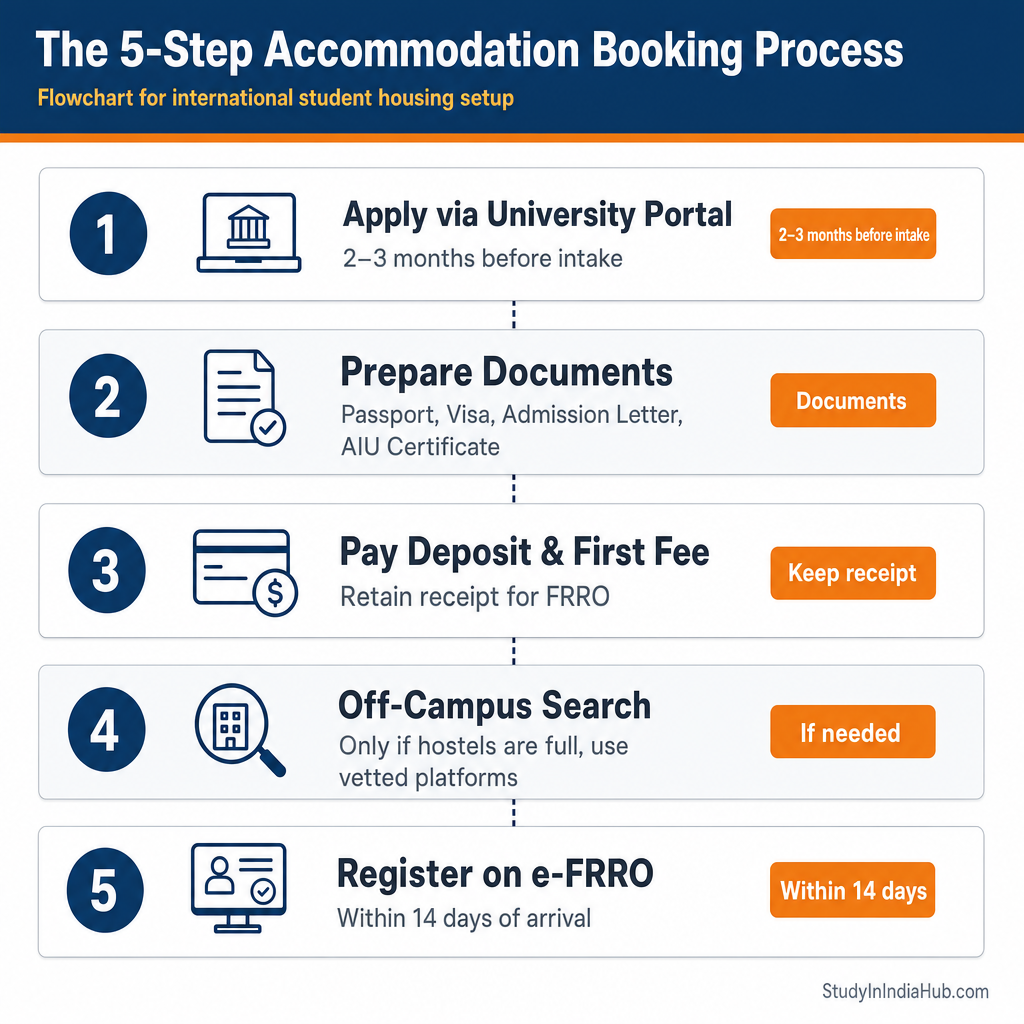
Reserve in this sequence. Submit your application via the university hostel portal initially. Then consider approved off-campus options. Only make payments after confirming the lease, deposit, and landlord’s identity. I've guided students through this countless times. The largest errors occur when a person reserves based on an arbitrary social media post lacking a formal offer or an authenticated university representative.
Top 5 Booking Mistakes to Avoid
The majority of accommodation issues stem from several preventable mistakes:1. Reserving through random social media posts or unverified WhatsApp groups, images often do not reflect actual conditions.2. Submitting the total payment prior to a video tour or document verification, after the funds are transferred, recovery becomes extremely difficult.3. Overlooking deposit terms, refund policies, and notice requirements hidden in the small print.4. Agreeing without a formal contract.5. Selecting a location distant from campus without evaluating the real commute and available transportation options.
Step 1: Apply Through the University Hostel Portal
Most universities begin hostel allocation 2–3 months prior to your intake. Spaces are occupied prior to the start of the semester. Submit your application on the same day your admission is verified. Students who delay until the visa is approved miss out on the best rooms.- Access your institution's international student portal (such as the SPPU International Centre) and complete the hostel application.- Processing requires 5–10 business days. You will receive an email containing your hostel allocation, payment details, and deposit deadline.- At BITS Pilani, the hostel fees are ₹36,000 per semester for the academic year 2026–27 (BITS Pilani). A hostel allocation letter simplifies your move-in process and your FRRO registration significantly.
Step 2: Have These Documents Ready
| Document | Notes |
|---|---|
| Passport | First and last four pages, self-attested |
| Student visa | With immigration endorsement |
| Admission letter | From your institution |
| 4 passport photos | — |
| Proof of funds | Bank statement covering fee + deposit |
| AIU equivalency | If required by your board (see below) |
Examine everything distinctly. Unclear phone images slow down processing by 2–3 weeks. Upload PDF files. Regarding equivalency: the UAE Secondary Certificate and Bangladesh HSC are acknowledged as equivalent to Class 12 by AIU. CBSE/IB are accepted directly. Some boards might require an AIU Equivalency Certificate (AIU Equivalence Division, Study in India). I witnessed a student miss out on their chosen room because AIU documentation took 11 days rather than 5.
Step 3: Pay the Deposit and First Fee
The university issues a payment invoice that includes the initial term fee along with a security deposit (typically equivalent to 1–2 months' rent, refundable). Make a bank transfer to the university account and retain the receipt. It is required for FRRO registration and your NRO bank account.Make timely payments. A student's payment processed 4 days after the deadline, resulting in her room being moved to the waitlist.
Step 4: Off-Campus — Use Vetted Platforms Only
If hostels are booked, try using NoBroker or 99acres. Avoid utilizing random listings on Facebook or WhatsApp. A price significantly lower than the local market range is a warning sign for fraud. Before transferring funds, request: complete address, owner's identification, draft of the rental agreement, terms for the deposit, move-in date, and refund conditions. Conduct a video call to view the room. Do not send a deposit until you or a reliable contact has inspected the property in person.
Step 5: Register on e-FRRO
Upon moving in, complete your registration with the FRRO within 14 days of your arrival (MEA India). The entire procedure is available online (e-FRRO Portal):1. Register for an account on the e-FRRO portal.2. Register for Application using your SII ID (your university student identification).3. Submit documents: copy of passport, visa page, admission letter, and photo.4. Submit, the majority of applications are handled within 24 hours. Utilize your hostel allocation letter or rental contract as proof of address. If you fail to meet the 14-day deadline, you could incur a penalty of approximately USD 30 (e-FRRO Portal).
Safety, Legal, and Cultural Tips for Students in India
The documents appear intimidating. Knowing the sequence makes it easy. Here’s what to address prior to and following your arrival.

Registration with FRRO
All international students, including Nepali students for the 2025-26 academic year, are required to register with the FRRO within 14 days of their arrival, regardless of the Indo-Nepal open-border treaty (e-FRRO Portal). The procedure is entirely online, with no need for an office appointment unless you are contacted: and adheres to the four steps outlined in the booking section above. A name discrepancy is the most frequent cause of delay. A Nepali student's registration lasted 3 weeks due to a name mismatch between his passport and admission letter. Verify the spelling of your name on all documents prior to your arrival.
Rent Agreements and Landlord Norms
Landlords in Pune and Mumbai are familiar with international students. They will request a copy of your passport, visa, and admission letter, routine, not intrusive. Always avoid paying a deposit until you have reviewed the original property papers.
Clarify upfront and get it in writing:
- Guests staying overnight: Certain PGs limit visitors, inquire beforehand.- Cooking regulations: Communal kitchens typically have timing and seasoning guidelines.- Deposits: Typically 1–2 months' rent, returned upon checkout- Notice period: Generally 30 daysYou'll require the written consent to establish a bank account (evidence of Indian residence) and for upcoming FRRO revisions (refer to Edu / RBI Guidelines).
Safety and Community
Safety differs from one neighborhood to another. The crime safety index in Bangalore is 46.25 (Numbeo), which is moderate and similar to various university towns.- Select housing close to campus or along major roads. Stroll through the neighborhood in the evening prior to making a decision.- Female students: Inquire at the international office regarding hostels or PGs exclusive to women.- Provide your address and landlord's contact information to your university's international centre and your embassy. If you hail from Nepal, connect with the vibrant student groups in Mumbai and Pune that host Dashain and Tihar festivities (Colleges Nepal).
Settling In: Your First Week Checklist
Manage communication initially, followed by documentation. One simple mistake can hold you back (e-FRRO Portal).
Your Week-One Checklist
- Obtain a local SIM at an authorized store using your passport, copy of your visa, a passport-sized photo, and proof of your Indian address. Activation typically requires 15–30 minutes (India Someday, Memorable India).2. Establish an NRO bank account using your passport, student visa, four photos, and university enrollment certificate.
Common Mistakes to Avoid
Locating suitable housing in India is just part of the challenge. Numerous students make the same preventable mistakes. Here’s what to look out for.
Underestimating the Local Lifestyle Adjustment
Don't think your home routine will directly apply in India. Cuisine, climate, and local culture differ significantly among cities such as Delhi, Bangalore, and Chennai. Explore the location prior to agreeing to anything. Engage with current students regarding their everyday experiences. An inexpensive apartment distant from campus can lead to higher expenses in commuting stress and transportation later on.
Submitting Incomplete or Incorrect Documentation
This is the error I observe most frequently. Universities and landlords require precise correspondence between your passport, visa, and admission letter. Verify the spelling of each name and the accuracy of the dates. Have your documents verified. Have both digital and hard copies prepared. A single incorrect detail can postpone your housing approval by weeks.
Missing Key Deadlines
Indian housing applications, hostel assignments, and registration periods progress quickly. Note each deadline as soon as it is given to you. Schedule reminders one week in advance. Avoid waiting until the final day. Portals fail and offices shut down sooner than anticipated. Missing a hostel slot might leave you searching for private rentals at high rates.
Frequently Asked Questions
Am I eligible to apply for DASA PG 2026 if I hold a PIO or OCI card?Indeed, but you should not have completed your studies in India during the 3 years leading up to your postgraduate application (DASA; Ministry of External Affairs). The most frequent mistake: students become ineligible after completing a final undergraduate year in India, believing the regulation applied solely to high school. Check your residency status prior to paying any non-refundable registration fees.
Is there a confirmed DASA PG 2026 schedule yet?
No. Official portals confirm the DASA PG 2026 cycle exists but don't yet show a date-wise schedule (DASA). Check the portal every Monday starting in March so you don't miss the registration window.
What if my name on my admission letter doesn't match my passport?
This blocks your FRRO registration and delays your visa, often by 3 weeks or more. One Nepali student we worked with was held up because his letter showed "Priya" but his passport said "Priyanka." Request a Bonafide Certificate with Corrected Name from your university's International Student Cell, issued on official letterhead with the Registrar's signature. Verify it matches your passport character-for-character before leaving the registrar's office.
How long does visa processing actually take?
Routine processing takes 5–15 business days (Indian Visa Online; VFS Global). Incomplete paperwork, discrepancies in names, or high enrollment periods during July–August can extend it to 6+ weeks. We've observed students forfeit deposits expecting a 10-day turnaround and receiving 25. Incorporate a 2-week cushion. Avoid linking your move-in date to the timely arrival of your visa.
Can I book accommodation before my visa is approved?
Indeed, under certain conditions. Most PGs and private flats reserve a room for 7–14 days with a nominal deposit of ₹2,000–₹5,000. University hostels need your acceptance letter and occasionally evidence of your visa application. Do not pay the complete deposit until the visa is obtained. Obtain a written provisional booking confirmation that details the hold duration and refund policy.
What should I budget for a shared PG room?
| City | Shared PG / Hostel | Mess meal plan | Eating out |
|---|---|---|---|
| Mumbai | ₹8,000–₹20,000/mo (Numbeo) | ₹3,000–₹5,000 | ₹6,000–₹12,000 |
| Pune | ₹4,000–₹12,000/mo (Numbeo) | — | — |
Yearly living expenses fall between $15,000–$25,000 (ImmiTalks), significantly lower than London's £18,348 (IDP).Is FRRO registration required for me if I'm residing in a university hostel?Affirmative. Every international student is required to register with the FRRO within 14 days of arrival, regardless of their place of residence. The hostel will not take care of it for you. Take your passport, visa, admission letter, and filled-out FRRO form. Registration is required but comes at no cost. Failing to do so may lead to penalties or visa termination.
About the Author
Priya Sharma, since 2018, Priya has assisted more than 2,000 international students with the Indian university admission and visa procedures. She began at SPPU's International Centre handling applications from over 40 countries and later joined StudyInIndiaHub.com to provide the same assistance online. Her expertise lies in visa documentation, FRRO registration, and admission requirements specific to each country.
How We Researched This Article
Every article is verified against original sources and examined by educators who have firsthand experience with international student admissions. Our information is sourced from official university sites, NAAC/NIRF databases, government visa websites, Numbeo cost-of-living statistics, and direct communication with university international student offices. Currency rates refreshed every day. Weekly updates on living expenses. Data from the university examined every three months. Students from Nepal that we have assisted frequently mention a similar obstacle during FRRO registration: a slight discrepancy between the name in their passport and the name on their admission letter. One recounted waiting almost three weeks for approval due to a different spelling of his middle name on various documents. The solution typically involves obtaining a correction letter from the university, which can slow down the entire process. Verify that each document employs the same spelling before you submit your application. Explore forums such as r/IndianStudents, and you'll see the same concern arises repeatedly: retrieving a security deposit after moving out, frequently long after the fact. A common issue is landlords subtracting unclear "maintenance" fees or remaining unresponsive when the lease concludes. Others recount conflicts regarding unwritten verbal agreements. This is why it's essential to record every term and the property's condition at the beginning.
Sources
- Chanakya University
- Wise
- University of Mumbai
- RBI / DNA India
- MEA India
- SPPU International Centre
- Careers360
- braingainmag.com
- Numbeo Mumbai
- Numbeo Delhi
- Numbeo Pune
- Numbeo Bangalore
- Study in India
- BrainGainMag
- Numbeo Pune Traffic
- SPPU International Centre
- AAI
- mu.ac.in
- Colleges Nepal
- BITS Pilani
- Study in India — FRRO
- NoBroker
- e-FRRO Portal
- Leverage Edu / RBI Guidelines
- Numbeo Bangalore Crime
- India Someday
- Memorable India
- DASA
- Ministry of External Affairs
- Indian Visa Online
- VFS Global
- ImmiTalks
- IDP