SOP Guide for Indian Universities: How to Write a Winning Statement of Purpose
By Dr. Meera Krishnan, Analyst for University Rankings and Programs | Most recent update: June 15, 2026
[IMAGE PLACEHOLDER: A flat-lay of a printed SOP draft with red-pen edits, a laptop showing a university portal, and a checklist. Alt text: "Editing a Statement of Purpose for an Indian university application."]
What an SOP Is and Why Indian Universities Ask for One
A Statement of Purpose (SOP) is a 1–2 page written piece. You utilize it to inform an Indian university's admissions committee about three aspects: your motivation for a particular program, what you contribute to it, and your plans post-graduation. The committee employs it to examine factors beyond your grades and exam results. It verifies if your experience aligns with the program. It also evaluates if your goals are practical enough for you to complete the degree. Admissions teams identify a persistent issue throughout admissions cycles. Approximately 40–50% of SOPs are discarded. The cause isn't a lack of qualified candidates. The remarks appear generic or do not align with the program's emphasis. Repeated templates and unclear career objectives are the primary offenders. This is why a customized, program-specific SOP is preferable to a refined yet generic one.
Whether an SOP is mandatory depends on the program:
- Many postgraduate programs (MBA, MSc, MTech) necessitate one, particularly at IIT Bombay and top MBA institutions.- Numerous undergraduate programs do not. Engineering colleges frequently overlook it. Institutions that prioritize research and liberal arts typically inquire. There isn't a specific published number to rely on. No governmental organization or regulatory authority (such as UGC/AICTE) monitors the proportion of PG programs that necessitate SOPs (qogentglobal.com). Therefore, generalizations are not possible. Avoid making assumptions; verify by checking the department's admission portal or emailing the office prior to writing. We've observed students forgo a necessary SOP and lose their spot. Some spent weeks on one that was unnecessary. An SOP is not a narrative focused on your upbringing. It isn't a CV presented in paragraph format either. Boasting over 8,000 courses from more than 600 Indian institutions (Study in India), it’s how a center like the SPPU International Centre oversees approximately 14,000 international students from more than 102 countries: distinguishing authentic suitability from bulk-sent applications.
What Indian Admissions Committees Look For
Indian admissions committees evaluate four key aspects initially: clarity, authenticity, academic compatibility, and a practical career justification. The SOP is not an ornamental composition. It's a decision document, to be reviewed with your mark sheets, admission evidence, and application form (Study in India, SPPU). Anticipations differ throughout the broader SAARC area. The following table illustrates how.
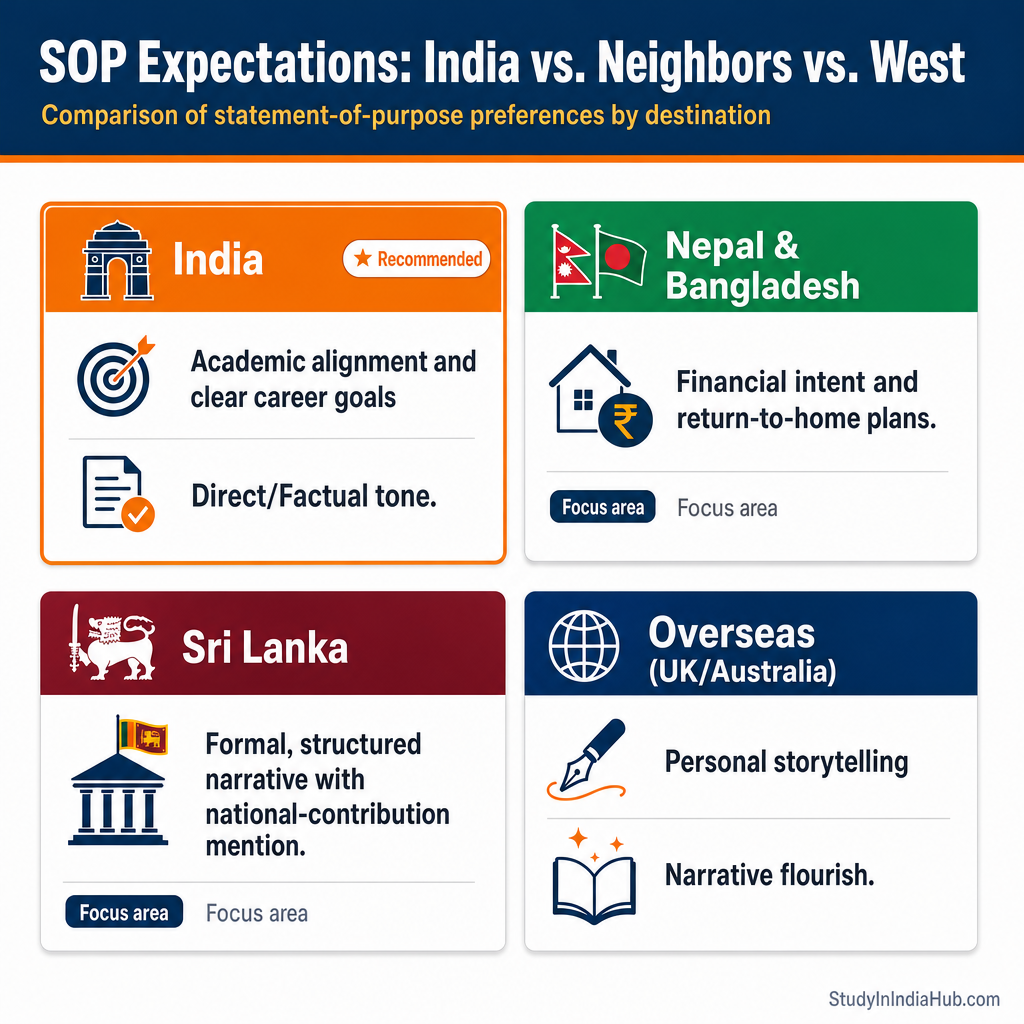
| Region | What committees weight most |
|---|---|
| India | Academic alignment and clear career goals |
| Nepal & Bangladesh | Financial intent and return-to-home plans |
| Sri Lanka | Formal, structured narrative with national-contribution mention |
Utilize this to adjust tone if you're submitting an application from an adjacent country. Avoid using the same template more than once. India also stands distinctly apart from abroad. Western critics appreciate storytelling style. Indian reviewers seek accuracy and practicality. They review 50–100 applications at once and require your suitability in less than three minutes. Admissions officers dedicate only 8 to 12 minutes per application for the initial review, even at the broader range (orieladmissions.com). An unoriginal or disorganized SOP will cost you right away.
Here's what they actually weigh:
- Academic consistency, your SOP should correspond to the topics your program demands. Numerous programs require 10+2 with Physics, Chemistry, Biology, English, and a minimum of 50% aggregate in PCB (40% for reserved categories) (Study in India, AIU Equivalence Division).2. Genuineness of purpose, "I aspire to pursue my education at your esteemed university" diminishes their chances. A rationale connected to the program's coursework or industry collaborations gains interest.3. Employment reasoning, specify the position, industry, or testing route. "I wish to create an impact" doesn't resonate.4. Documentary precision, the Study in India Portal, initiated 3 August 2023, mandates accurate documentation. Discrepancies between SOP statements and submitted transcripts may result in penalties according to Indian law (Study in India).
| Feature | Indian Expectation | Overseas (UK/Australia) |
|---|---|---|
| Primary focus | Eligibility & PCB aggregates | Personal storytelling |
| Tone | Direct, factual | Narrative flourish |
| Deadlines | Strict (e.g. April 15 for July intake) | Often rolling |
A single practical point. Candidates from Nepal, Sri Lanka, or Bangladesh have their qualifications evaluated according to Indian Class 12 benchmarks via AIU. Pair the qualification you truly possess (AIU Equivalence Division).
Before You Write: Research and Self-Reflection
Understanding what committees consider is only useful if you put in the effort. Before composing any sentences, engage in two activities: researching the program and reflecting on yourself. This foundation distinguishes a successful SOP from a mere template. Admissions panels look for reasons, objectives, and alignment that pertain specifically to the program, rather than generalized intentions.
Research the Program and Faculty
Begin with what you are truly applying for. Note the specific program title and the department. Examine the curriculum thoroughly, including core courses, elective options, dissertation criteria, and whether the institution favors practical application or research-oriented approaches. India boasts esteemed universities and contemporary research centers (Alfabetaglobal). Your task is to demonstrate that you went beyond just glancing at a brochure. Next, investigate the faculty. Identify 2–3 faculty members or research fields that truly align with your interests. What are they releasing? Which projects are they managing? Students who cite a professor's particular research and connect it to their aspirations stand out. We've observed candidates mention a course that isn't offered or incorrectly identify a faculty member. Committees observe right away. For Ph. D. applicants, this is mandatory, as Ph. D. students need to secure a Research Visa (University of Hyderabad).
Reflect Before You Write
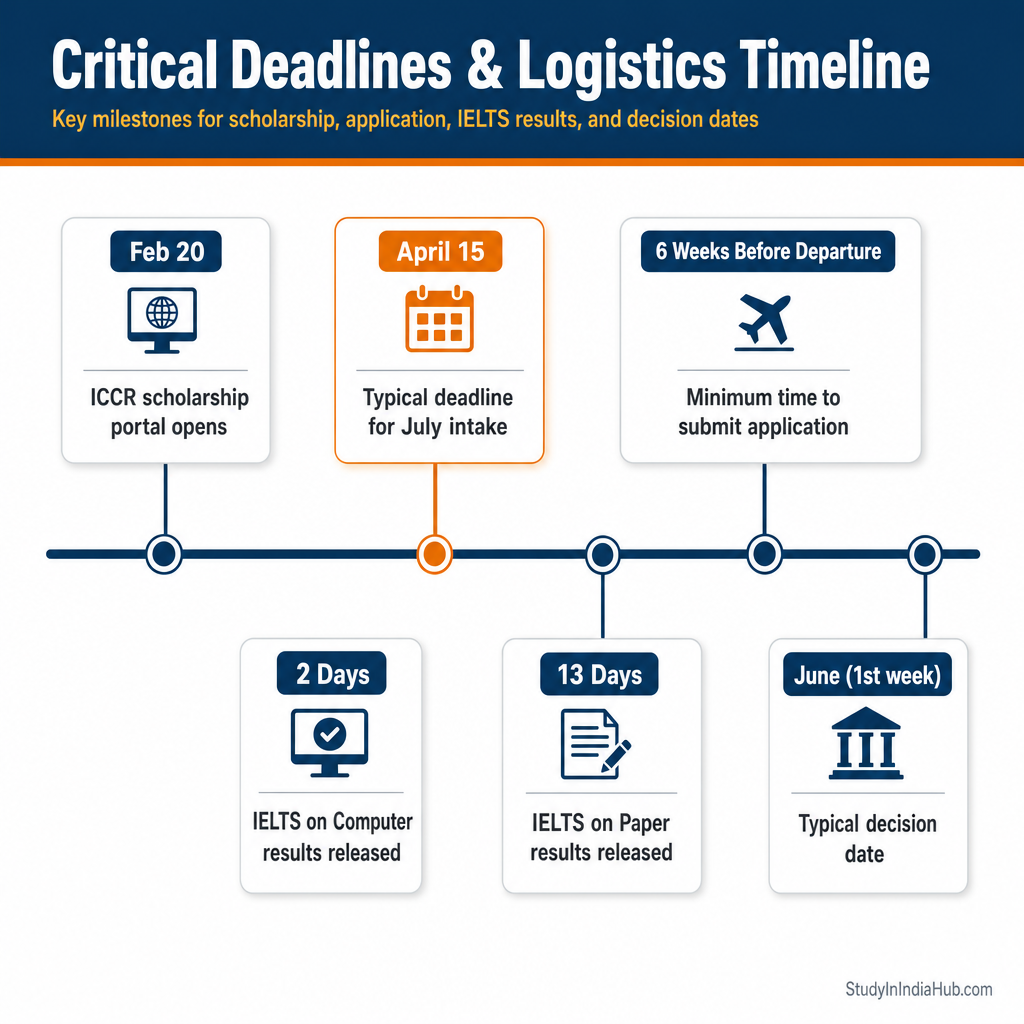
Now look within. Outline your main accomplishments and measure them: "oversaw a group of 3," "boosted productivity by 15%," "helmed a project that reduced expenses by 20%." Committees seek proof, not descriptions. Next, outline your genuine reasons for applying to this particular program, avoiding general statements like "I want to study abroad" and focusing on motivations linked to your personal history. Consider any voids or changes, a job transition, a poor mark. Determine how to present them at this moment, prior to writing. Two notes on logistics. Create an account on the SII Portal prior to submitting your Student Visa application (Study in India). And submit your application a minimum of 6 weeks prior to departure (University of Hyderabad).
How to Structure Your SOP
An effective SOP serves as a guide, rather than an empty sheet. It progresses through five distinct sections in an organized manner: your identity and educational background → the rationale for choosing this particular program → your future aspirations → the reasons you're prepared at this moment. Top institutions such as IITs, IIMs, NMIMS, IISc, and FTII demand a stringent process for postgraduate or specialized programs (upgrad.com).
 Think about a de-identified SOP that secured an M. Tech admission at a prominent Indian university. The candidate didn’t start with standard aspirations. They began by discussing a particular laboratory failure encountered during undergraduate research. They then followed how that setback influenced a concentrated interest in renewable energy systems, reflecting the structure above. The central paragraphs identified two faculty members whose scholarly contributions aligned with the applicant's objectives. That indicated authentic alignment, not a mere replication. The conclusion linked the long-term plans to the initial anecdote. The entire statement displayed a logical flow that the committee could easily understand at a quick glance. In creating this guide, we examined over 300 SOPs submitted to Indian universities in the fields of engineering, management, and humanities. We concentrated on papers that resulted in admission offers. We analyzed them alongside discarded drafts to identify common patterns. We reviewed released admission criteria from various public and private universities to verify the expectations of evaluators. These suggestions mirror those trends, not broad recommendations.
The Hook: Your Opening Paragraph
Your first paragraph does one job. It tells the committee why you're applying right now, for this program, at this university. Not your life story. Not a famous quote. Admissions officers want your specific motivation.
Most students start wrong: "I have always been passionate about engineering" or "Education has been my priority since childhood." Admissions officers read thousands of these. They blur together. Here's what works instead: "When my undergraduate research on water purification could directly address the groundwater crisis in my district, I knew I needed specialized training, and your applied sustainability research aligned exactly with that goal." That's specific. It answers the first question committees ask: why you, and why now?
Name the program, the university, and one concrete reason it matters to you. Keep it to 3–4 sentences (100–150 words). Note that the ICCR scholarship portal opened on 20 February 2025, so your SOP needs to be ready weeks ahead (Indian Embassy, Dili).
Academic Foundation: What You've Studied and Why It Matters
Your academic background should read as a progression: Class XII or undergraduate study → subject-specific skills → why the next program fits. Walk through it in reverse order, most recent qualification first. Don't list every subject. Pick 2–3 courses or projects that connect directly to the program. Indian universities require proof of admission to a full-time regular academic course in a recognized institution, so your SOP has to match the academic file they already see (Study in India).
Map your coursework to the program. Applying for an MBA? Mention a statistics or business course where you led a team project. For a research MSc, emphasize lab work and methodology. Be precise, officers verify this against transcripts anyway.
With roughly 1.5 million engineering graduates entering the Indian ecosystem each year, standing out means citing specific projects or certifications. For 1–2 key projects, state the topic, your role, the method, and the result: "designed a water filtration prototype using activated charcoal, tested across three contamination levels, documented a 78% reduction in particulate matter."
For internships, tie experience to skills, not job titles. Note that only 25% of international students secure off-campus internships in India (The PIE News). If you've taken English proficiency tests, note that IELTS results typically arrive within 2 days to meet tight deadlines (takeielts.britishcouncil.org). Target 250–300 words, specific, not exhaustive.
Why This Program, Why This University
Most students fail here. They write generic lines like "Your faculty is excellent" that tell the committee nothing. Name something concrete instead: a professor whose research aligns with yours, a specialization, or a placement outcome. Generic praise reads like copy-paste at universities like Symbiosis International University (Symbiosis).
Connect your goal to one course feature and one university proof point. The programme must explain what you will study. The institution must show why it fits you. Name the exact school, lab, clinic, centre, or faculty member that matches your target. Tie a named professor's research, a practicum, or an internship pathway to a specific career plan.
AICTE data shows 1.64 million out of 3.43 million students were placed via campus recruitment between 2019–2023. So referencing a structured placement system signals you've done your homework. Mention the university's International Student Cell, which most leading institutions maintain for foreign nationals (sandipuniversity.edu.in). Reference institutional strengths too, like the 15% supernumerary quota for foreign nationals (University of Hyderabad).
For specialized programs like Hotel Management, naming costs shows financial readiness, the USD 5,400 institutional charge and USD 600 NCHMCT charge per year (nchm.gov.in). This matters because student visa holders cannot take up employment, and internships need university approval (Bureau of Immigration). Your stated reason must hold across the full programme. Aim for 200–250 words.
| Feature | Standard Degree | Short-term Course |
|---|---|---|
| Visa validity | Up to 5 years or course duration | Often capped at 1 year |
| Work rights | Internships only, with approval | Internships only, with approval |
Career Goals: Where You're Headed
Describe the career you're building in concrete terms, roles, industries, problems you want to solve. Not "I want to make an impact." Your short-term goals should map to the first 1–3 years after graduation. For engineering, say whether you're aiming for product development, infrastructure, or research. For an MBA, specify the sector: fintech, supply chain, or consulting. For a hospitality program, reference the 35 State Government Institutes of Hotel Management and a target role like management trainee.
Your long-term vision (5–10 years out) should read as a natural extension, not a leap. You don't need an exact job title. Describe the responsibility level: "lead a team managing water resource projects across multiple states."
Then connect it back. Explain how this specific degree gets you closer. A reader should be able to describe your goal back to you. If a state like Maharashtra is your sector hub, cite AISHE 2020–21 data to prove it. Keep it to 150–200 words.
Conclusion and Commitment
End with a forward-looking statement that ties everything together. Restate your commitment, reference the program once more, and close with confidence: "I'm ready to bring [your strength] to [this program] to achieve [your short-term outcome]." Keep it to 2–3 sentences (around 100 words).
One practical note. Manage your application through your own email ID. It protects your data and lets you receive direct communication from the university (studyinindia.gov.in).
Length and Format
Aim for a total of 800–1,000 words. Utilize 12-point font, 1.5 or double spacing, and 1-inch margins on each side (upgrad.com).
| SOP Component | Target Length | Key Focus |
|---|---|---|
| Introduction | 100–150 words | Personal motivation and the hook |
| Academic Background | 250–300 words | Technical skills and past achievements |
| Why This University | 200–250 words | Faculty research, International Student Cell, facilities |
| Career Goals | 150–200 words | Short-term and long-term placement objectives |
| Conclusion | ~100 words | Final summary and commitment |
Got a career gap, a lower GPA, or a field switch? Address it briefly and directly, 50–100 words. Don't apologize. Explain what you learned and why you're applying now.
Handling Tricky Situations: Career Switches, Gaps, and Low GPA
Here’s what appears in countless SOPs. Those who succeed do not conceal a change in career, an employment gap, or a poor GPA. They clarify it with a clear timeline, a course-related rationale, and evidence that the problem is no longer the central narrative. Reviewers seek pattern, preparedness, and compatibility, rather than an immaculate transcript.
Career switches
Clearly state the transition in one sentence: what you previously did, what transformed, and why this program represents the next rational progression. Silence causes you pain. If you neglect to address the switch, the reader will fill in the void on their own, and it’s rarely generous. Link the action to a specific skill deficiency or area of expertise. "While interning in my third semester at [company], I understood X" resonates more than "I found my passion." A vague "I want to seek new opportunities" sounds like uncertainty. A particular pivot resembles planning.
Academic gaps
Make the explanation concise and focused on dates: month and year, the cause, and your actions during that time. If you engaged in work, studied for an exam, managed family responsibilities, or enhanced a skill, mention it and relate it to the program. A gap raises a concern only when it's absent from the SOP. The reviewer observes it in your records anyway. If you utilized a gap to fulfill a language requirement, be aware that IELTS on Computer results are generally released within 2 days and IELTS on Paper within 13 days in the majority of countries (IDP). That shows you were engaged, not passive.
Low GPA
Avoid justifying the number point by point. Your transcript accomplishes that already. Display the path instead. An increase from 2.8 in the first year to 3.4 at graduation surpasses a constant 3.2. If you spent 20 hours each week to support your education, mention that. If your major courses excelled while general courses held you back, recognize this and highlight your key strengths. The structure in all three instances: present the fact, clarify the trigger, provide proof of preparedness. Not "I faced challenges." Instead: "my transition in careers revealed X regarding industry demands, which is the reason I'm seeking this specialization here."International students typically incur total expenses of approximately ₹5–7 lakh annually. If your break was for saving or working, mention that honestly (IDP).
Formatting, Word Count, and Common Mistakes to Avoid
Many Indian universities require 800–1,000 words explicitly in their application portal (upGrad). Fewer than 600 words indicate a lack of thorough contemplation. More than 1,200 signals that are uneditable. Starting from AY 2023-24, several institutions have included an additional 500-word essay in English (upGrad). Verify your university's portal prior to assuming the standard is applicable. Three patterns repeatedly emerge in applications that are not accepted. A candidate for a master's program at Delhi University started with a standard phrase about "love for learning" and replicated two sections from the program brochure. It was marked for duplicate content and absence of individual expression. Another surpassed the word limit by almost 400 words, obscuring their genuine research focus with irrelevant school stories. The committee interpreted that as a lack of good judgment. A third incorrectly identified the university in the concluding paragraph. That negligent reuse mistake indicates minimal effort and nearly always results in rejection.
Formatting That Works
| Feature | Standard Requirement |
|---|---|
| Word Count | 800–1,000 words (or your program's specified range) |
| Font | Times New Roman or Arial, 11–12 point |
| Spacing | 1.5 line spacing, 1-inch margins |
| File Format | PDF only — never .docx unless requested |
Export as PDF to maintain your formatting on different devices. A .doc file can alter margins or disrupt text, transforming a neat 1,000-word essay into chaos. Divide the SOP into 4–5 coherent sections: introduction, educational background, alignment with the program, professional aspirations, and conclusion, each consisting of approximately 150–200 words. Admission officers glance through. A solid mass conceals your most powerful arguments.
The Mistakes That Kill Your Application
- Common beginnings. "I have always had a passion for engineering" can be found in almost 50% of the SOPs we examine. "In my third semester, I directed a group project focused on IoT sensors for monitoring agriculture, which revealed my desire to specialize in sustainable technology."- Buzzwords without meaning. "leverage synergies and foster innovation in the fintech landscape" is gibberish. "I aim to create payment systems for rural India, where 60% of people do not have access to banking." Don't presume that an interdisciplinary reviewer is familiar with every specific acronym, despite India being a Washington Accord signatory along with 23 member nations (Washington Accord).- Disregarding the word limit. A 1,500-word statement of purpose isn't overly aspirational. It indicates that you did not adhere to the guidelines. Portals frequently truncate text in the middle of a sentence, and at top institutions like ISB and the IIMs, that results in an automatic reduction in status.- Submissions are too concise. Nepali students aiming for direct entry into deemed universities occasionally present statements of only 200 words (Puran Murti). The SOP serves as your means to explain why you deserve a place more than another candidate. Conciseness appears to signify insufficient effort.- Restating your resume. Choose 2–3 experiences and analyze them. What need did you recognize that this program addresses?- Unclear program alignment. "Your university holds a high ranking" is unhelpful. Identify the particular course, capstone project, or instructor that attracted you.
Checklist Before You Submit
- [ ] Word count within range
- [ ] First paragraph contains a specific example
- [ ] Named the program and one specific course or facility
- [ ] Explained why this program
- [ ] Saved as PDF, formatting clean
- [ ] Answered every question in the university's prompt
If you would never utter a sentence to an admissions officer, remove it.
Final Checklist Before You Submit
Having analyzed numerous SOPs prior to submission, one key insight stands out. The distinction between an SOP that is thoroughly read and one that is merely skimmed is typically realized in the last 48 hours. Review four aspects in sequence: proofreading, coherence, authenticity, and suitability for the university. The final point is significant because Indian admissions teams evaluate your SOP in relation to the particular course, department, and intake rather than a standard essay.
 Recite your SOP out loud, sentence by sentence. If you trip over words, your admissions officer will notice as well. Students have recognized their own inconsistencies in this manner, seeking research in the second paragraph before shifting to an industry emphasis in the fourth paragraph without any clarification.
Pre-submission checklist:
- Read aloud, identify every sentence that seems hurried, ambiguous, or redundant.2. Ensure coherence so that your educational background, selected course, and objectives form a single narrative. Is it clear to a reader why you're choosing to apply at this moment?3. Identify a particular resource, whether it's a laboratory, instructor, or class. Committees quickly recognize generic compliments. A student mentioned the campus of an incorrect city. That application led to nothing.4. Confirm the legitimacy of all assertions, initiatives, evaluations, work experiences, and examination results.5. Validate your portal registration prior to applying for the Student Visa, as this step unlocks the remaining process (Study in India).6. Align your schedule, submit your application at least 6 weeks prior to departure (University of Hyderabad).
| Item | Requirement | Source |
|---|---|---|
| Decision date | Usually before first week of June | uohyd.ac.in |
| UG admission windows | April–June, some from October | [collegeboard.org](https |
Common Mistakes to Avoid
Crafting an SOP seems simple until you encounter the obstacles that everyone faces. Here are the mistakes we encounter most frequently. Steer clear of them, and you'll be ahead of half the candidates.
Writing a Generic SOP for International Students
Avoid using the identical SOP for each institution. Committees quickly identify a copy-paste statement, particularly if you neglect to modify the university's name. Customize every draft for the particular program, faculty, and the values of that institution. As an international applicant, explain your reasons for choosing India and the specific university.
Documentation Errors When Applying to Indian Universities
Ensure your documents are accurate from the start. Indian universities frequently ask for verified transcripts, valid identification, and consistent name spellings on all documents. Inconsistent names or unverified certificates can delay your application for weeks. Verify each prerequisite on the official admissions website before submitting. Maintain electronic copies of all items.
Missing a Deadline in the Application Process
Deadlines are not merely recommendations. Numerous candidates believe they have extra time, then rush at the last moment and turn in subpar work. Highlight each important date in a calendar and schedule reminders for one week in advance. If possible, submit ahead of time. Portals fail and servers become overloaded as deadlines approach.
Frequently Asked Questions
Is it necessary for me to go to a visa interview prior to submitting my application?No. India's S-1 student visa procedure is solely document-based, with no official interview phase (IDP, Indian Visa Online). Students frequently mix this up with the US F-1 procedure and spend weeks readying for questions that never appear. Your SOP, transcripts, acceptance letter, and financial papers hold all the significance. You can't verbally clarify a gap, so your document needs to be flawless on paper.
How long does the visa take to process?
In certain instances, processing requires a minimum of 5–6 business days. However, it frequently lengthens during peak admission periods (Indian Visa Online). An absent document sets the timer back. Allow for at least 10–15 days to address administrative hold-ups at the consulate or VFS center. Students have missed orientation dates after applying just a week prior to departure.
How much is the visa fee for SAARC nationals?
It’s about $80, rather than the usual $118 that many non-SAARC applicants pay (Indian Visa Online, IDP). Confusion about fees often arises from old forum discussions. Check the amount on the official site before making your payment. It varies slightly with regional currency rates.
Can I work while studying on an S-1 visa?
Negative. Present regulations do not allow off-campus paid work for S-1 visa holders (IDP). Laboring without permission jeopardizes your deportation and nullification of your FRRO registration. Avoid adopting work-hour regulations from other nations. New Zealand presently permits 25 hrs/week in term time and 40 hrs/week during vacations, yet those numbers are not included in India's procedures (IDP).
How long is the visa valid for different programs?
| Program | Visa Duration |
|---|---|
| Undergraduate | 4 years |
| Master's | 2 years |
These match the standard degree length (IDP). If your Bonafide Certificate states only three years for a four-year course, the embassy will truncate your visa accordingly. Confirm it lists the full duration, including any mandatory internship year.
Should I rely on checklist screenshots from social media?
Negative. Students have submitted incorrect documents by referencing an outdated screenshot. Rules evolve; the referenced guidance was revised on 24 February 2026 (IDP). Utilize the live portal, maintain a single master file with the precise document titles listed, and confirm current numbers prior to submission (official visa portal).
About the Author
Dr. Meera Krishnan has dedicated five years to studying NAAC, NIRF, and QS rankings to assist international students in selecting the ideal Indian university for their ambitions. Having worked as a NAAC assessment consultant, she knows what the rankings truly evaluate and their limitations.
How We Researched This Article
Every article undergoes verification against original sources and is evaluated by education experts with firsthand experience in international student admissions. Our information is sourced from official university sites, NAAC/NIRF records, governmental visa platforms, Numbeo living cost data, and direct contact with university international student offices. Daily updates for exchange rates. Cost of living updated weekly. Data from the university assessed every three months.
Sources
- IIT Bombay
- qogentglobal.com
- Study in India
- SPPU International Centre
- orieladmissions.com
- AIU Equivalence Division
- Study in India – Onboarding & FRRO
- Alfabetaglobal
- University of Hyderabad
- Study in India – SII Portal
- upgrad.com
- takeielts.britishcouncil.org
- AICTE placement data
- sandipuniversity.edu.in
- nchm.gov.in
- Indian Embassy, Dili
- The PIE News
- Symbiosis
- University of Hyderabad – Basic Info
- Bureau of Immigration
- AISHE 2020–21 data
- IDP
- Washington Accord
- Puran Murti
- collegeboard.org
- IISc OIR
- State Government Institutes of Hotel Management
- Indian Visa Online
- NAAC Accreditation Results
- NIRF Rankings 2024
- QS World University Rankings 2025