When to Apply to Indian Universities: Intake Calendar 2026-2027
Authored by Dr. Meera Krishnan, Analyst for University Rankings and Programs | Most recent update: June 15, 2026
India's Two Main Intake Seasons at a Glance
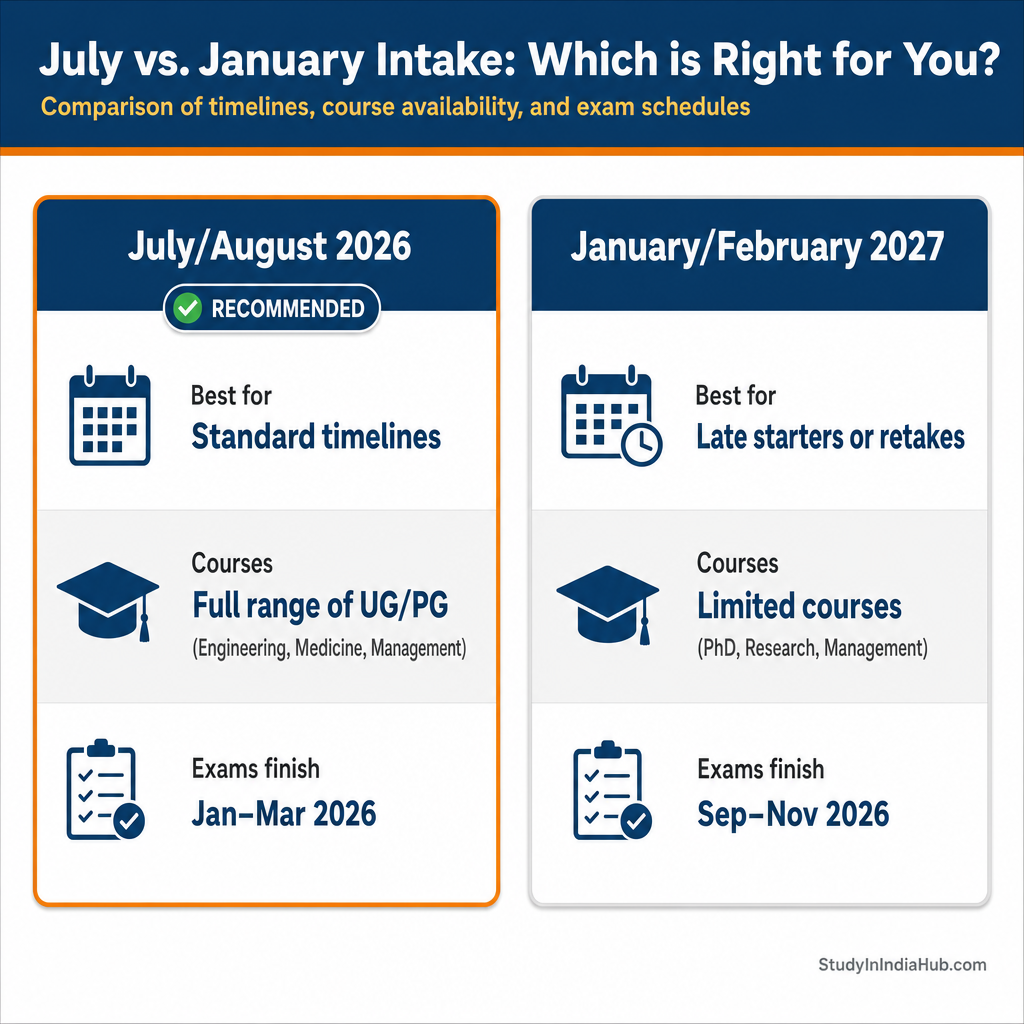
India has two enrollment periods. Determining which option aligns with your schedule is your initial choice. The July/August intake serves as the main cycle. At that time, most universities accept students. Competitive exams conclude, and the school year starts. The January/February intake is less extensive and more discerning. It is appropriate only for certain circumstances.
| Intake | Best For | When Exams Finish | Course Availability |
|---|---|---|---|
| July/August 2026 | Most students; competitive exam takers; standard timelines. Engineering, medicine, management, humanities. | January–March 2026 | Full range of UG/PG programs |
| January/February 2027 | Late starters; students retaking exams or who missed July deadlines. Research, certificates, exchange. | September–November 2026 | Limited; mostly PhD or short-term |
The July enrollment is where the quantity is. Entrance tests such as JEE Main, CUET, and university assessments predominantly take place from January to March 2026. The majority of admission outcomes arrive around April to May. That period allows universities to manage visa applications prior to the beginning of classes. The January enrollment is a fallback option, not a strategy. It has a smaller number of seats and a reduced number of participating universities. If you're still making a choice in March 2026, January 2027 is your feasible goal. Upon arrival, complete your registration with E-FRRO within 14 days (Study in India).
Intake Calendar 2026-2027: Month-by-Month Timeline
Begin your planning at least 12 months prior to your arrival on campus. In exam-gated programs, failing to register on time has no option for a late-fee remedy. You postpone for another year. Recently, 15,38,468 distinct candidates appeared for the JEE Main in both sessions (NTA). That illustrates how constrained seat planning becomes. The table below serves as the backbone of the 2026–2027 cycle. It encompasses the main July intake and the January winter intake.

The Complete 2026-2027 Timeline
| Month / Period | What Happens | What You Should Do |
|---|---|---|
| May–July 2025 | Research universities, courses, eligibility | Shortlist from 150+ top institutions; separate government/NIT/IIIT/central options from private (Study in India) |
| Sept–Oct 2025 | Intensive JEE/NEET prep window | Start coaching if your course needs an entrance test |
| Oct–Nov 2025 | Registrations open for JEE Main, NEET, CUET | Register early; keep the confirmation slip safe |
| Dec 2025–March 2026 | Competitive entrance exams conducted | Some institutions open in October with December exams—track each target individually (edmaster.co) |
| Feb 20, 2026 | National application portal opens | Confirm whether your institution uses this cycle or a separate institute-level window (Study in India) |
| March–April 2026 | Government universities, NITs, IIITs, central universities open applications after results | Apply as soon as the portal opens (Study in India) |
| April–June 2026 | Most undergraduate admission windows run | Treat April as the real opening month, not a backup (edmaster.co) |
| Before first week of June 2026 | Admissions Committee decisions communicated | Track status; keep alternatives ready (uohyd.ac.in) |
| July–August 2026 | Primary term begins | — |
| January 2027 | Winter intake term begins | For PG and research programs (Alfa Beta Global) |
Why the Timeline Matters More Than the Dates
What students overlook is that the application period differs from the exam period. The period from April to June 2026 spans approximately 8 weeks. Admission boards make their decisions prior to the initial week of June (uohyd.ac.in). A late application, even by one week, either ends up in a different group or is placed on a waitlist. This moves a July appointment to January. Submit your application no less than 2 weeks prior to your intended deadline (Study in India). Universities handle data in groups, rather than in real time. If the due date is June 15, send it in by June 1. This similarly mitigates portal issues and document validation.
Two Country-Specific Traps
- Sri Lanka: Starting from 03.11.2025, applications should be submitted directly at the High Commission, 36-38 Galle Road, Colombo 03. Submissions occur from 0930–1300 hrs, while collections take place from 1530–1700 hrs (Study in India). A tardy file does not meet the same-day deadline.- Nepal: Starting from 2025-26, Nepali students are required to register with the FRRO even with open-border regulations. This extends 5–7 business days following acceptance (Study in India). Avoiding it poses risks of fines or issues when leaving during semester breaks.
Time Your English Test
If your course requires IELTS, computer-delivered results are available in 1–5 days. Paper-based results may take as long as 13 days (British Council, ielts.org). A submitted score is frequently the final item needed for submission. Reserve by March to prepare for the surge in April. Another verification: certain institutions allow foreign nationals up to 15% of the sanctioned intake (uohyd.ac.in). Qualifying doesn't guarantee it automatically. A delay of two weeks may allow prior applicants to occupy that spot.
July/August 2026 Intake: Key Deadlines
The main admission period is the July/August 2026 intake. The majority of deadlines occur between April and May 2026 (Study in India). This cycle offers the highest number of course options and scholarship opportunities. It also holds the largest seat capacity, allowing foreign nationals to be accepted up to a 15% supernumerary quota beyond a program's sanctioned intake (NITI Aayog). The 15% figure is the norm for institutions approved by AICTE (AICTE). A few organizations take it a step further. HEIs can establish a maximum of 25% additional seats specifically for international students, designated only for holders of foreign passports (NLU Assam). Fail to meet these cutoffs and you frequently forfeit an entire year. Numerous specialized technical and medical courses do not resume for the shorter January session.
The three application routes
| Route | Portal/Authority | 2026 Deadline |
|---|---|---|
| ICCR Scholarship | A2A Portal | Opens 27 Feb, closes 22 April 2026 |
| General Admissions | SII Portal | April–May 2026 |
| DASA (Engineering) | DASA notice | Specific 2026 dates not yet public |
| Direct (e.g., SPPU) | University Portal | Varies (notices from March) |
- ICCR Scholarship (A2A Portal): The application period is limited, available from 27 February to 22 April 2026 (Embassy of India, Seoul). Indian Missions will complete selections by 31 May 2026 (ICCR Timeline). If you miss April 22, you forfeit the tuition waiver and stipend for that year.2. SII Portal: This main platform created by the MoE, MEA, and MHA typically reflects the April–May deadline for collaborating institutes (Study in India). Submit sooner, as certain popular programs may close prior to the final deadline (IDP).3. Direct entry to university: SPPU released its 2026–27 UG/PG international admission announcement on 4 March 2026 (SPPU Admissions). University cutoffs may shift ahead of the main timeline. Verify the specific quota for each institution as well. National Law University & Judicial Academy, Assam, for example, allocates 15% of the total seats for both PG and UG programs for international students (NLU Assam). What we commonly observe is that students focus on the university deadline and overlook the earlier scholarship deadline. A university could take direct applications until June, but ICCR selection ends on 31 May. Two useful guidelines. Initially, specific dates differ among universities and programs (IDP). Consider the public window as your final possible date, rather than your goal. Next, ensure your English proficiency results are prepared by January. Numerous pathways will necessitate Higher English (B2) starting in 2026 (IDP). Take the exam by the April deadline, and you won't receive scores.
January/February 2027 Intake: Key Deadlines
The January/February 2027 enrollment represents a more limited spring session. Based on my experience, only a few Indian universities and programs utilize it. Deadlines typically occur between October 15 and November 30, 2026. The specific date relies on if you are applying to a private university or a specialized management school. This cycle primarily assists students who either missed July 2026 or complete 10+2 on an alternate academic schedule. A public master list of all spring courses does not exist. Consider this as a window for admissions by program. Check each university's portal prior to making plans based on it. If your course isn't available for spring, there are no alternatives. For UG admission, completion of 10+2 (12 years of higher-secondary education) is mandatory (Study in India). If your transcripts arrive after November, you risk losing your spot. In 2022, Indian universities admitted 46,878 international students from 170 nations (AISHE). For more detailed insights, the AISHE 2020–21 report categorizes international students by country, educational level, and state (VIT). The latest statistics originate from the AISHE 2023–24 report, the most current data accessible as of 2026 (NITI Aayog). Prominent government institutions such as IIT Bombay (international B. Tech fees set at ₹323,350/year) seldom offer new UG slots in January (IIT Bombay). Private and deemed universities, currently about 41.4% of the sector: are generally more adaptable. This intake is utilized for MBA, Ph. D., and particular B. Tech programs (Ministry of Education). For VIT, anticipate B. Tech fees of US$3,000–$5,000/year for international students (VIT).
| Feature | July/August Intake | January/February Intake |
|---|---|---|
| Application Deadline | March – June | October – November |
| Course Availability | All Programs | Limited (Mostly PG/Management) |
| University Type | Public & Private | Primarily Private & Deemed |
| Competition | High | Moderate |
If you aim for SPPU, utilize their specific international admission portal. It has managed all international applications since the 2015–16 period (SPPU). If you miss the November deadline, you typically have to wait until July, as visa processing and FRRO registration require advance time before the semester begins.
Working Backwards: When to Start Your Application
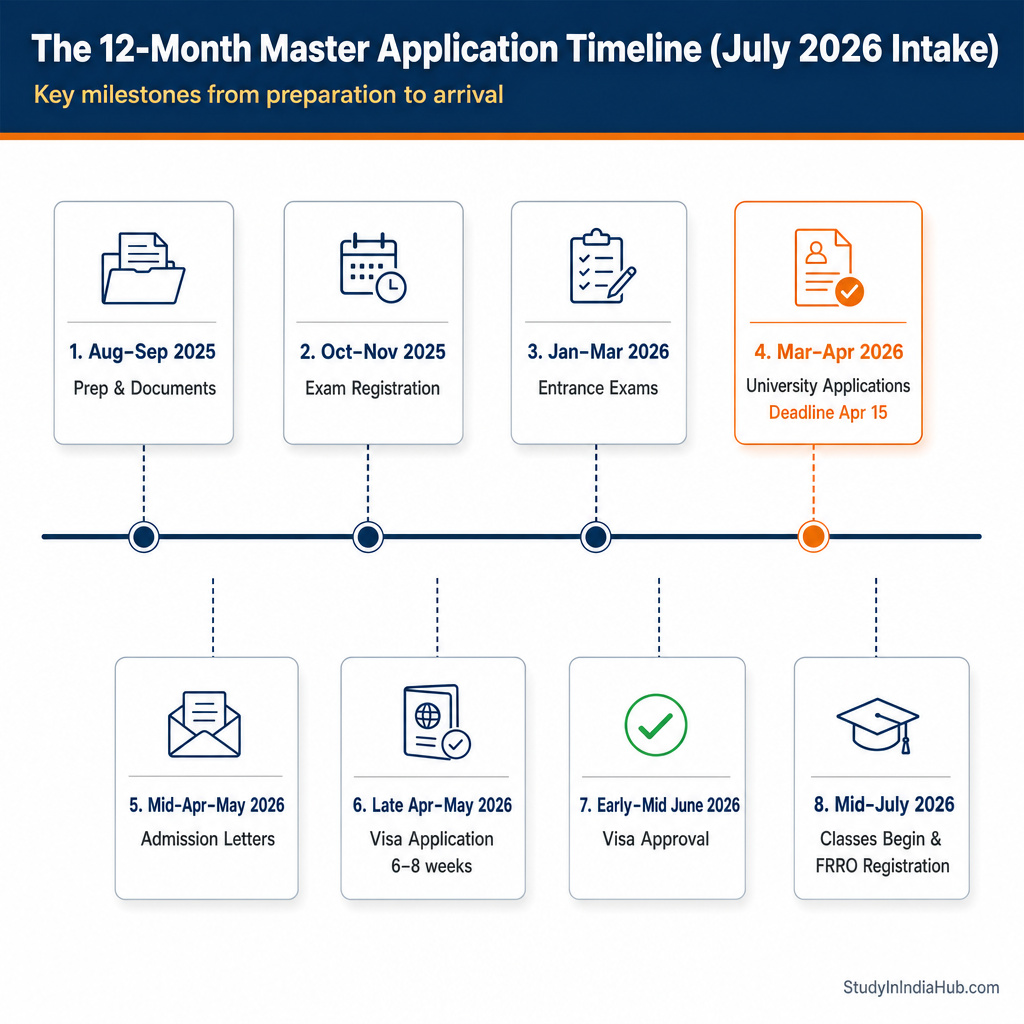
Submit your application 9–12 months prior to your desired intake. Begin from the term start and trace back through exam registration, document preparation, and visa processing. This is not random. It's the only method to handle delays without forfeiting your seat. The reverse timeline in this document matches released academic schedules from prominent Indian universities with actual processing information. We calculated the average turnaround times for student visas from the 2024–2025 cycles. We subsequently included buffer windows in accordance with existing FRRO requirements. We considered document certification and embassy appointment delays from recent entries. Where official dates change annually, we highlight the differences rather than presuming set deadlines. The majority of Indian universities commence their academic year in mid-July. Several programs also begin in January. The University of Hyderabad establishes April 15 as the application cutoff for any year starting in mid-July. That one date grounds everything else.
Where Students Miscalculate: Visa Processing
Indian student visas (S-1) require at least 3 working days for processing. However, that represents the minimum, not the standard. In reality, processing takes 2–8 weeks based on nationality, completeness, and time of year. At times of high demand (June–August), anticipate 6–8 weeks or more. The official website recommends submitting applications at least 2 weeks ahead. I've witnessed students miss their July intake by sending in applications in late May, anticipating 3 days and encountering the highest backlog instead. Count backward from the university's deadline, not from the date you receive your admission letter. The procedure is online, anonymous, cash-free, and digital, with no official interview. Delays stem from insufficient documentation, not from interview availability.
The Backward Timeline for a July 2026 Intake
| When | Action |
|---|---|
| Aug–Sep 2025 | Begin entrance exam prep; start gathering documents |
| Oct–Nov 2025 | Complete exam registration; finalize academic records and financial proof |
| Jan–Mar 2026 | Take entrance exams; receive results |
| Mar–Apr 2026 | Submit university applications (Hyderabad deadline: April 15) |
| Mid-Apr–May 2026 | Receive admission letters |
| Late Apr–May 2026 | Submit S-1 visa application (allow 6–8 weeks) |
| Early–Mid June 2026 | Receive visa approval |
| Mid-July 2026 | Classes begin; complete FRRO within 14 days |
For a January 2027 enrollment, change all timelines: university application deadlines occur September–October 2026, exams take place July–September 2026, visa processing is done October–November 2026, and document preparation begins March–April 2026.
Documents to Pull Six Months Out
You will require academic transcripts, admission confirmation from an accredited university, and proof of financial backing. Collecting these takes more time than you realize. Transcripts take 2–4 weeks to process. Bank statements and sponsorship letters need to be up-to-date and notarized. The equivalency of overseas qualifications takes an additional 1–2 weeks. Bangladeshi students need to verify that their HSC is officially recognized as equivalent to the Indian 12th standard.
Two details that catch people out:
- Utilize your personal email ID on the portal. Essential communication is located here. A common family email account or an overlooked spam folder prevents students from receiving their approval notification.- S-1 visas are granted for the length of the program or for a maximum of 5 years. If your course is longer than 180 days, you must register with the FRRO within 14 days after your arrival (Study in India).
Deadlines at Major Universities
A recurring observation I have: students behave as though every Indian university operates on the same academic calendar. They do not. Each institution establishes its own deadlines within the overall schedule. Failing to meet a specific deadline can set you back an entire year. These are the two universities that people inquire about the most.
Savitribai Phule Pune University (SPPU)
SPPU has approximately 10,000 international students from more than 100 countries, the highest count among Indian universities. Its International Centre operates a well-established, centralized system (SPPU International Centre). Submissions are handled by the Centre, which ensures deadlines are strict and uniformly upheld. If the portal shuts on May 15th for July enrollment, it shuts. There is no extension to discuss. Provide your bachelor's degree, academic transcripts, and evidence of English proficiency by that deadline. Since intake is dependent on capacity, consider document verification, hostel allocation, and departmental approval as components that may take longer than the main deadline.
University of Mumbai
Mumbai University operates in a unique manner. International student services operate at the department and college level, rather than through a single central office (University of Mumbai). Deadlines differ depending on the location of your application. A Science faculty program may end on May 20th, whereas Commerce concludes on May 10th. You might not meet a faculty-specific cutoff even though the overall university calendar appears to be available.
CUET and what to verify
For CUET-based undergraduate admissions, required at Central Universities and various state and private universities: you can't rely on memory for planning. Monitor the NTA announcement regarding CUET 2026 (NTA/CUET). The test typically occurs in April–May, with enrollment commencing beforehand. If your course necessitates CUET, that exam date serves as the strict deadline that influences all other timelines. If you are submitting your application from Nepal, Bangladesh, Sri Lanka, UAE, Kuwait, or any part of Africa, you generally apply via the appropriate Indian High Commission, Embassy, or Consulate (edvoy). Reach out to your closest mission in January, not in May.
Your action steps:
- After you have selected 2–3 universities, obtain the official 2026–27 prospectus from each institution. Avoid depending on broad timelines.- Create a spreadsheet featuring columns for: university name, deadline date, submission method (portal/email/mail), and the international admissions contact email.- Verify each admission page with the Study in India Portal or the pertinent entrance-test announcement prior to submission. I've seen students miss SPPU's cutoff by three days, expecting that Mumbai University's deadline would align with it. They never did. A year gone.
Timing Mistakes That Cost Applicants a Year
What we frequently observe is a student forfeiting an entire academic year due to one missed deadline. The errors aren't related to effort. It's about underestimating the number of elements that need to come together before the mid-July intake. Data on admissions conveys a distinct narrative. AISHE data indicates that a large portion of international applicants fail to secure their desired intake annually. Numerous postpone until the next cycle. University admissions offices cite two frequent reasons: tardy academic transcripts and postponed visa paperwork. The expense is seldom merely documentation. This frequently implies a wait of six months to an entire year for the subsequent opportunity. Every year, two additional mistakes surprise applicants unexpectedly. The initial issue is mistaking the university application deadline for the entrance exam registration deadline. These often occur several weeks apart, and failing to meet the exam deadline can completely disqualify you, even with a fully submitted application. The second is misjudging the duration of document verification. Obtaining attestation or apostille for transcripts, degree certificates, and migration certificates may require three to six weeks. It takes more time if your prior institution is slow to reply. We have also witnessed students miss out on a year by disregarding scholarship and hostel deadlines, which frequently end prior to the main admission cutoff. We collaborated with an applicant aiming for a July 2026 admission to a management program at a university in Delhi. They presented documents.
Common Mistakes to Avoid
Treating all intakes the same
International students frequently believe that all programs have a July start date. That isn't correct. Numerous courses commence annually, and certain scholarships are linked to particular enrollment periods. Verify the specific enrollment for your selected program prior to creating your timeline. Avoid depending on a friend's experiences from another university.
Submitting incomplete or incorrect documents
Documentation undermines more applications than poor grades. Obtain your transcripts, mark sheets, and degree certificates for attestation promptly, as the procedure may require several weeks. If your documents are in a different language, organize certified translations ahead of time. Verify the spelling of your name on your passport, certificates, and application form. Even minor discrepancies cause rejections.
Missing critical deadlines
Deadlines at Indian universities are stricter than many anticipate. Avoid postponing the submission of your application until the deadline. Consider visa processing, fund validation, and document authentication. They all consume your timeline. Record all deadlines in a calendar and set reminders for two weeks prior. Submit your application early, and you create time to address issues before they lead to disqualifications.
Frequently Asked Questions
Is it possible to apply to several universities for the same admission period?Indeed, and you ought to. Submit applications to 4–6 universities from various tiers, including one or two ambitious options, two or three target schools, and one or two fallback institutions. Every university features its unique portal and deadline, so spread submissions over 2–3 weeks instead of sending everything at once on a single day. The majority of institutions do not punish students for submitting multiple applications, but check each website to confirm this first.What happens if my entrance exam results aren't available by the deadline?Numerous universities allow a conditional application indicating that your score is forthcoming. However, your offer remains contingent upon reaching the threshold. Certain individuals need the score prior to reviewing you completely. If you're nearing the deadline, contact the admissions office via email at least two weeks beforehand. Verify if a pending-score notification is approved.
Can I work while studying in India?
Typically not. India's standard student visa is aimed at full-time education. Off-campus or part-time employment is not allowed (IDP). Working without authorization may lead to visa revocation and deportation by the FRRO. In comparison, nations such as New Zealand permit 25 hours/week during the academic term and 40 hours/week during holidays (IDP).
How long is the visa granted for different programs?
Undergraduate students generally obtain a 4-year visa, while Master's students are granted a 2-year visa (IDP). Ensure your passport remains valid for at least six months after your visit. If the duration of your visa doesn't match your offer letter, obtain written clarification from the university before you arrive.
Are the English requirements changing for 2026?
Certainly. Yes. Numerous pathways will demand a higher B2 level starting January 2026 (IDP). If you intended to present the lowest score from a previous intake guide, begin preparing for IELTS or TOEFL in advance. Not meeting B2 standards can lead to rejection at the department level.
How does attendance affect my visa status?
Institutions are now subject to more rigorous sponsor compliance, featuring a 95% enrollment and attendance requirement (IDP). If you fall below the required threshold, the university is obligated to notify the FRRO through the S-Form on the FSIS portal. That can terminate your education no matter the fees paid.What happens if I miss a deadline by a couple of days?The majority of portals shut down at midnight and do not accept tardy submissions. I've witnessed students miss their July intake by submitting at 11:59 PM on the incorrect date. Submit a minimum of 24 hours in advance. Some schools have a grace period of 2–3 days for technical problems, but it’s not always assured.
About the Author
Dr. Meera Krishnan, for five years, has examined NAAC, NIRF, and QS rankings to assist international students in selecting the appropriate Indian university for their objectives. Having worked as a NAAC assessment consultant, she knows what the rankings truly evaluate and their limitations.
How We Researched This Article
Each article is verified against original sources and assessed by education experts who have firsthand experience in international student admissions. Our information is sourced from official university sites, NAAC/NIRF databases, government visa websites, Numbeo cost-of-living statistics, and direct interactions with university international student offices. Exchange rates refreshed each day. Weekly updates on living expenses. University information assessed every three months.
How India's Visa Timelines Compare
| Country | Typical Visa Processing Time |
|---|---|
| India (peak intake) | 6–8 weeks |
| UK | 3–4 weeks |
| Australia | 3–4 weeks |
| Canada | Variable, sometimes 8+ weeks |
In contrast to the UK and Australia, where student visa approvals typically take three to four weeks, processing times in India can extend to six or eight weeks during busy intake periods. The timelines for Canada's study permits are also inconsistent, occasionally taking more than eight weeks for specific categories of applicants. Based on our observations, students who regard India's deadlines as similar to the quicker UK turnaround tend to undervalue the visa cushion they require. Adding an extra month before your July or January enrollment distinguishes between a seamless beginning and a postponed admission.
Sources
- January and March 2026
- SPPU
- Study in India
- NTA
- edmaster.co
- uohyd.ac.in
- Alfa Beta Global
- British Council
- ielts.org
- Study in India
- NITI Aayog
- AICTE
- NLU Assam
- A2A Portal
- University Portal
- Embassy of India, Seoul
- IDP
- Study in India
- AISHE
- VIT
- IIT Bombay
- Ministry of Education
- VIT
- SPPU
- a minimum of 3 working days to process
- processing averages 2–8 weeks depending on nationality, completeness, and season
- University of Mumbai
- NTA/CUET
- edvoy