How to Apply to Indian Universities as a Foreign Student (2026)
Authored by Dr. Meera Krishnan, Analyst of University Rankings and Programs | Most recent update: June 15, 2026

Can Foreign Students Study in India? The Short Answer
Affirmative. Indian universities welcome international students for undergraduate, postgraduate, and research programs. The figures are significant. Savitribai Phule Pune University accommodates approximately 14,000 international students from over 102 countries, representing the largest international group at any university in India (SPPU International Centre).
You have three main routes for the 2026 intake:
- SII Portal, a unified governmental platform introduced on August 3, 2023, by three ministries (Education, External Affairs, and Home Affairs). It encompasses over 8,000 courses from more than 600 institutes (Study in India Portal).2. DASA (Direct Admission of Students Abroad), for engineering and architecture at leading technical institutes (DASA).3. Direct application, applying directly to institutions such as IIT Bombay, which ranks 3rd in engineering (NIRF: Engineering). This manual details the entire 2026 cycle. You will discover eligibility criteria, entrance tests, document requirements, application procedures, and visa authorization.
The Three Admission Routes for International Students
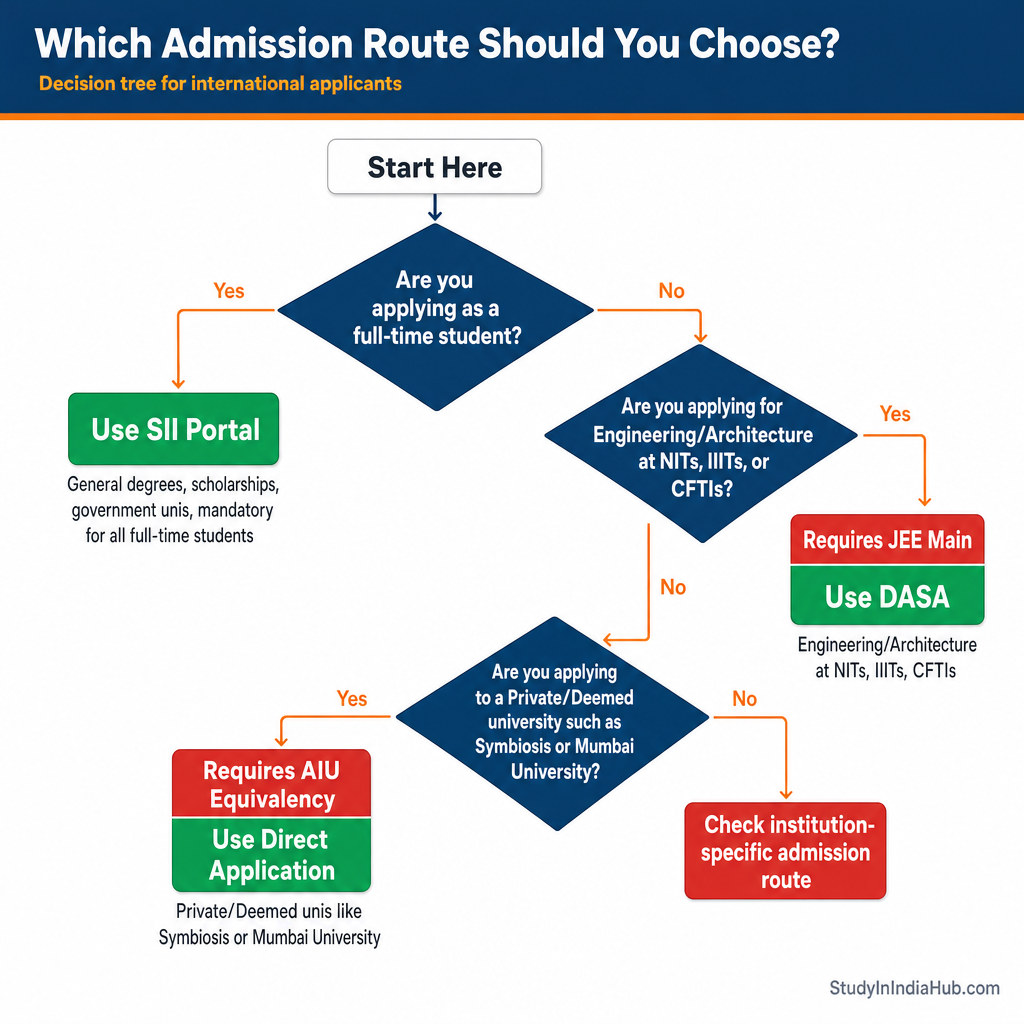
Choosing the incorrect path results in losing an entire intake cycle. Your path is influenced by what you are studying and the kind of institution you desire.
Route 1: The Study in India (SII) Portal
The Study in India portal is the main access point for the Government of India, managed by the Ministry of Education. All international students studying full-time are required to register here. The SII Unique ID is essential for your student visa (immitalks). Create a single account, upload your documents a single time, and submit applications to numerous central, state, and certain deemed universities. It is the sole pathway to the SII Scholarship, which may fund tuition and living expenses. What it isn't: the path for engineering or architecture at NITs, IIITs, or CFTIs. That is distinct.
Route 2: The DASA Scheme (Engineering & Architecture Only)
The Direct Enrollment of Students Overseas program manages UG and PG Engineering, Architecture, and Planning. It encompasses NITs, IIITs, SPAs, IIEST, and various other Centrally Funded Technical Institutions (DASA). It is available to Foreign Nationals, OCIs, PIOs, and NRIs. A 2026 note: as of 2021, SAT scores are no longer valid for DASA engineering. La única norma aceptada para el rango JEE Main es (edmaster). The sole exception is IIIT Hyderabad. It operates its own DASA procedure and continues to accept SAT. The price difference is significant yet remains affordable by worldwide metrics:
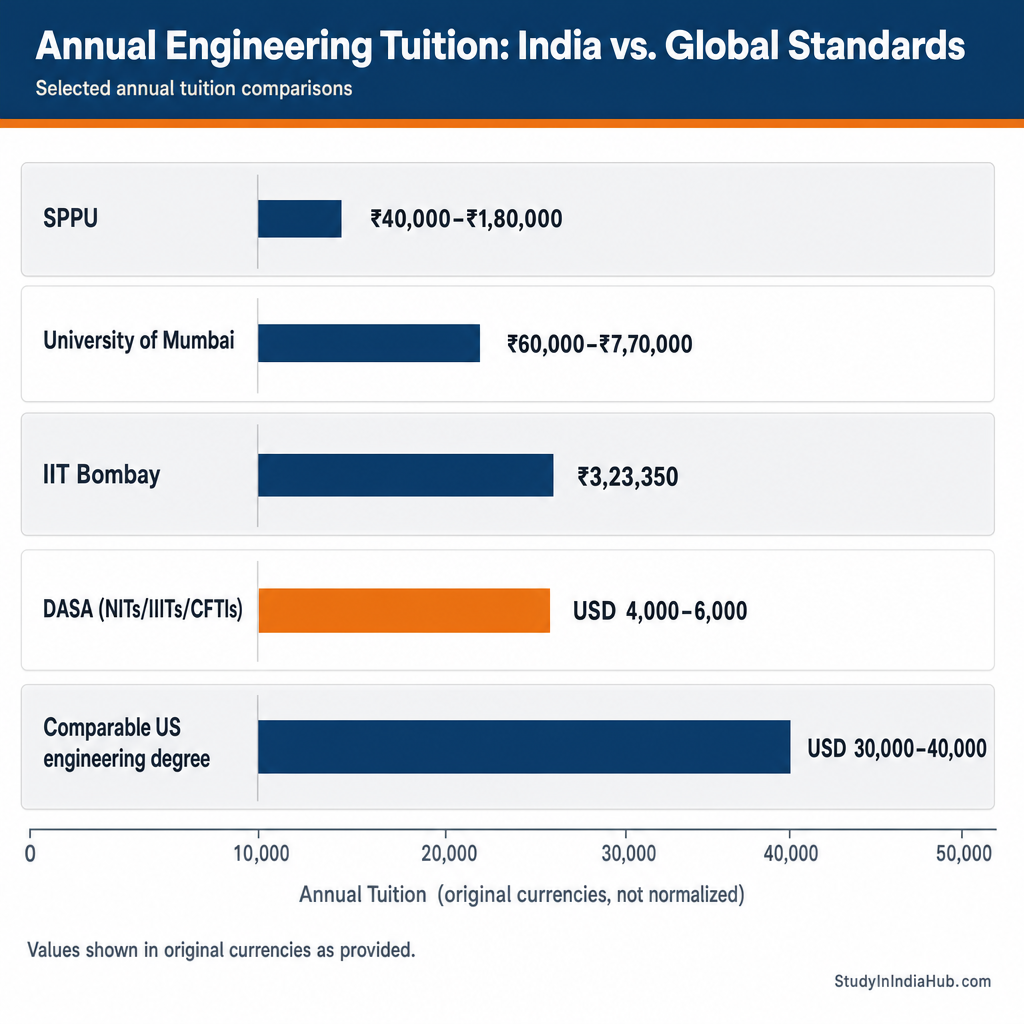
| Option | Annual Tuition |
|---|---|
| DASA (NITs/IIITs/CFTIs) | USD 4,000–6,000 (DASA) |
| Comparable US engineering degree | USD 30,000–40,000 (DASA) |
A DASA PG 2026 program is in place. Specific dates have not been announced yet (DASA).
Route 3: Direct Application to Private & Deemed Universities
Private and deemed universities constitute approximately 41.4% of higher education in India (Study in India). They operate autonomously, without SII portal or DASA. You submit your application directly to the international office of each institution. Instances consist of Symbiosis International University and the University of Mumbai. This pathway offers the most adaptable timelines. However, you need to manage your own Equivalency Certificate from the Association of Indian Universities (AIU).
Which Route Applies to You
| Route | Best For | Mandatory Registration |
|---|---|---|
| SII Portal | General degrees, scholarships, government universities | Yes — all full-time students |
| DASA | Engineering/architecture at NITs, IIITs, CFTIs | Yes — for technical seats |
| Direct Private | Specialized/private degrees | No (SII still advised) |
- Pursuing a degree in engineering or architecture? Visit DASA initially.- Are you from a SAARC nation? Check for specific quotas. The Central University of Himachal Pradesh imposes an additional INR 2,000 fee for SAARC students (CUHP). The Colombo Plan Technical Cooperation Scheme provides as many as 50 training opportunities from the Government of India (Colombo Plan).- Every undergraduate applicant must have 12 years of education (10+2) as a minimum requirement (Study in India). Prior to collecting documents, dedicate 30 minutes to the official website of your target school. Verify which path it takes. Then adhere to it precisely.
Do You Need Entrance Exams? (JEE, NEET, CAT and What Foreigners Skip)
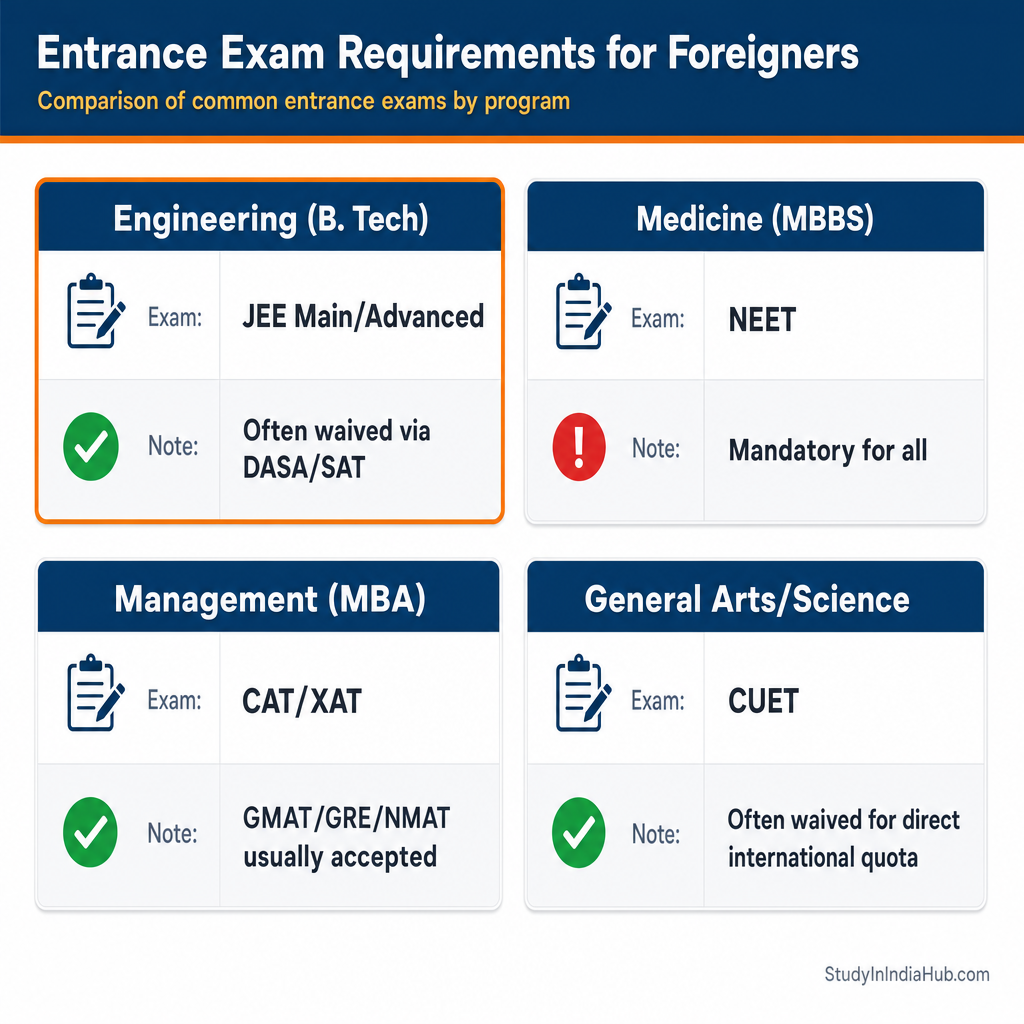
The majority of international students do not require the JEE or CAT. However, NEET is essential for entering medicine. The exam you take is determined by the admission pathway, not merely the degree title. Students spend weeks preparing for the incorrect exam. The ease arises from admissions based on quotas. The UGC allows colleges to establish a maximum of 25% additional seats exclusively for international students (Study in India). These seats are counted separately from the standard admission tally. Thus, you are accepted via a different pathway, not through the national entrance-test competition. These additional seats frequently arrive lacking an entrance exam (economictimes.com). Start by reviewing the international admissions page, then look at the exam rule. When a foreign-seat block is present, the process typically involves eligibility, comparable grades, and document verifications, rather than a test ranking. Check the UGC circulars directly for the 2026 exam waivers.
| Course Type | Common Exam | Foreign Student Requirement |
|---|---|---|
| Engineering (B. Tech) | JEE Main / Advanced | Often waived via DASA / SAT scores |
| Medicine (MBBS) | NEET | Mandatory for all applicants |
| Management (MBA) | CAT / XAT / GMAT | GMAT / GRE / NMAT usually accepted |
| General Arts/Science | CUET | Often waived for direct international quota |
Engineering
Don't presume that all international applicants need to take JEE. Programs such as DASA allow the use of SAT or GRE scores instead (DASA). Tuition varies significantly by institution:
| Institution | Annual Tuition (International) |
|---|---|
| IIT Bombay | ₹3,23,350 (NIRF — Engineering) |
| University of Mumbai | ₹60,000–₹7,70,000 (Mumbai University) |
| SPPU | ₹40,000–₹1,80,000 (SPPU) |
Medicine
NEET is compulsory for MBBS and BDS, applying to both foreign nationals and NRIs (NTA). If you miss the registration, you won't be able to "buy your way" into a seat afterward. The MBBS tuition fees for international students at the University of Mumbai range from ₹25,000 to ₹5,00,000 annually. Missing the exam closes the opportunity before fee planning begins (Mumbai University).
Management
Leading private institutions recognize the GMAT or NMAT from overseas candidates (LPU). The University of Mumbai enrolls MBA students at ₹42,600–₹84,000 annually without requiring the domestic CAT (Mumbai University). If you completely miss exams, have your 12th-grade scores validated by the AIU. This prevents a rejection at registration right before the deadline.
Eligibility and Documents You'll Need
The first three things I verify are academic equivalence, proof of identity, and evidence of admission. Your previous education should be aligned with the level you're seeking. Your passport needs to be spotless. You have obtained admission to a full-time regular program (studyinindia.gov.in). If equivalence is absent, your file halts before any interview or payment of fees.
Academic Eligibility
For undergraduate admission, the minimum requirement is 10+2 with a minimum of 50% in Physics, Chemistry, Biology, and English for medical-related courses. Certain reserved categories require just 40% (ICCR). For postgraduate enrollment, a bachelor's degree in a relevant discipline from an accredited institution is required (studyinindia.gov.in).PIO/OCI applicants adhere to distinct regulations. For UG, you need to have been studying overseas and not in India for the last 5 academic years. For PG, the gap for India studies is 3 years (ICCR). Nepali nationals may register with just a university registration approval, without needing a formal visa. UAE candidates represent a varied scenario. The UAE Secondary Certificate along with CBSE/IB is acknowledged directly. Other boards might require an AIU Equivalency Certificate. If your board is not explicitly mentioned, have the equivalency assessed promptly. The manual verification process for foreign boards continues to require 2–4 weeks (studyinindia.gov.in).
| Requirement | Specification | Source |
|---|---|---|
| UG Academic Min | 10+2 with PCB & English (≥50%) | ICCR Guidelines |
| English Proficiency | IELTS Academic 6.5 (where required) | ICCR Guidelines |
| Passport Validity | Minimum 6 months beyond stay | Study in India |
| Financial Proof | $8,500–$10,000 per year | ICCR Guidelines |
Document Checklist
- Genuine passport with a minimum of 6 months validity past your visit and two empty pages for stamps (studyinindia.gov.in).2. Evidence of enrollment in a full-time regular program at an accredited Indian institution (studyinindia.gov.in).3. Academic records and completion certificates for Class XII or your undergraduate degree.4. AIU equivalency, in case your board is not explicitly acknowledged.
Step-by-Step: How to Apply
Once your documents are prepared, initiate two simultaneous processes. First, submit your application to the university. Next, manage the visa associated with any offer that comes in. You cannot initiate the visa process without an acceptance letter from a partner institute of Study in India (studyinindia.gov.in). The greatest error isn't incorrectly completing the form. It's uncertain which portal to begin with.
 Consider a Nepali candidate we assisted in obtaining a B. Tech in Mechanical Engineering. Their journey began in August 2025. They completed registration on the ICCR portal and submitted applications to three universities. They provided transcripts, a copy of their passport, a medical fitness certificate, and proof of English proficiency. The main holdup was the attestation from the Indian Embassy in Kathmandu. It required almost six weeks. Begin that step ahead of time. They received an acceptance letter by January 2026 and submitted their visa application along with the university's genuine letter. They completed the relocation prior to the July enrollment.
Step 1: Shortlist the program and route
First, refer to the university's official admission page. Next, verify if the institute is a partner of Study in India. For applicants applying directly, the access points for the University of Mumbai and Pune University are available on their official international admissions websites. Save these early. Particular URLs vary with each cycle, and the procedure isn't centralized. Using the incorrect portal could lead to losing an entire intake. If you are thinking about Vijaybhoomi University, applications are now available for the 2026 undergraduate session (studyinindia.gov.in).
Step 2: Gather your documents
Prior to handling a form, gather transcripts, a copy of your passport, proof of English proficiency (if necessary), and a statement of purpose. The specific list varies by your program, refer to the international admissions page. Avoid waiting for "perfect" paperwork. Certify them now, as any hold-ups will lead to delays in visa processing later on.
Step 3: Complete and submit the form
Align your name precisely with your passport. Choose the appropriate program. I once observed a student's July intake postponed to January due to their middle name being spelled in two different ways. Preserve a copy along with the application reference number. You will require it for all that comes next.
Step 4: Upload documents and pay the fee
Submit scans and make payment via the specified method (bank transfer, card, or gateway). The actual problem isn't the charge. It's about whether the payment appears on your dashboard. Maintain the receipt along with the application number. Clearance may take 2–3 business days, and the university will not process your file until it is reflected.
Step 5: Track your status
Review the portal on a weekly basis. If the university requires additional documents, typically within a 5–7 day period: submit precisely what they request, not an improved version. The time from submission to decision typically spans 4–8 weeks.
Step 6: Receive your offer letter
Upon acceptance, the university provides your offer letter for admission, which is essential for moving forward. For Study in India paths, you proceed to apply online for visa and immigration services using your registered USER-ID (studyinindia.gov.in). Preserve it precisely as provided.
Step 7: Plan your timeline
Submit your application a minimum of 6 weeks prior to your intended departure (uohyd.ac.in). To enroll in July, apply by March. For January, target September–October. Following your proposal, the portal recommends submitting your registration application at least 2 weeks in advance (studyinindia.gov.in).
Route-specific notes
- Nepal: Directly apply through university websites or use the ICCR A2A portal for undergraduate, postgraduate, and doctoral programs (eoiriyadh.gov.in). FRRO registration remains necessary in 2025-26, even with the Indo-Nepal open-border agreement.- Additional nations (Bangladesh, Sri Lanka, UAE, Kuwait, Africa, Middle East): submit applications via the appropriate Indian High Commission, Embassy, or Consulate (edvoy.com).- OCI holders: qualified according to section 7B(1) of the Indian Citizenship Act, 1955. International students are ineligible for integrated Ph. D. programmes (oir.iisc.ac.in). Evaluate city compatibility early. Mumbai requires at least ₹15,000/month (Numbeo, Mumbai). Pune begins at ₹12,000 (Numbeo: Pune).
Application Timeline and 2026 Intake Dates
India operates two primary intakes. The July enrollment is the main one, featuring the highest number of seats and the greatest level of competition. The January enrollment is limited. The guideline for students is straightforward: begin the previous spring for July; begin the previous summer for January. This cushion safeguards you from document shortages and visa holdups. Why begin so soon? Processing an Indian student visa typically requires a minimum of 3 working days under normal circumstances. In certain cases, it may require 5–6 business days, while during peak season it may extend to 6–8 weeks (Indian Visa Online, Qogent Global). In reality, visas typically take 2–8 weeks. It relies on the nation, file thoroughness, and time of year. The layout of the two 2026 intakes looks as follows, arranged in reverse order:
| Action Item | July 2026 Intake (Main) | January 2026 Intake |
|---|---|---|
| Research & shortlist | Apr–May 2025 | Mar–May 2025 |
| Prep documents & exams | Jun–Aug 2025 | Jun–Aug 2025 |
| Submit applications | Sep–Nov 2025 | Sep–Oct 2025 |
| Offer letter received | Apr–May 2026 | Nov 2025 |
| Visa application | Dec 2025–Mar 2026 | Nov–Dec 2025 |
| Travel checks & arrival | Jun 2026 | Dec 2025 |
A few things we stress to students:
- You may select up to 3 Departments/Centres while applying. Thus, creating a shortlist is important (Study in India).- The visa is submitted through an online, centralized system. Ensure your file is organized before submission. It's not "send and be patient."- For January routes, anticipate elevated English requirements (B2 level) on numerous paths from January 2026 (IDP). Separate the timing for intake, scholarship, and visa. The January intake is limited, yet that does not expedite the visa process. Processing continues to rely on the mission and the time of year. Check the most recent visa statistics on the official website prior to booking flights (Study in India).
Student Visa, Arrival and Registration
After receiving an admission offer, three requirements must be fulfilled before you can become a registered student: a Student Visa (S-1), SII registration, and FRRO registration. Visa processing durations differ by mission. Delays in July and August can extend timelines even more. Therefore, submit your application well before your start date. Median information for specific missions, such as the High Commission in Colombo, is not accessible to the public. Confirm schedules with your closest Mission.
The Student Visa Application
Your primary visa is the Student Visa (S-1). It is solely based on documents, and there is no consular interview (Bureau of Immigration). Students occasionally spend time preparing for "visa interview questions" that aren't part of India's procedures. You may apply only upon receiving a formal admission offer letter from an accredited Indian institution. Deliver the document to the closest Indian Mission or VFS center (Study in India). The document typically requests:- Scholarly transcripts- Admission verification- Proof of monetary assistanceFor extended degree programs, Missions provide a visa that is valid for a maximum of 5 years or the duration of the course, depending on which is shorter (Study in India). Verify this with your course letter prior to arranging travel. A 2-year master's program grants a 2-year visa. A bachelor's degree takes 4 years to complete. A significant limitation: student visa holders are not allowed to work. Internships require approval in writing from the university (Bureau of Immigration). If you intend to work following your graduation, you must obtain an Employment Visa. It presently needs a total yearly income exceeding US$25,000 (around Rs. 16.25 lakhs annually) (Bureau of Immigration).Nepali citizens are exempt: A visa is not required. You can enter India freely and only require a student permit/registration from your university. You will still finish SII and FRRO registration.
SII Registration and FRRO
The order is important: visa → SII registration → arrival → FRRO within 14 days → bank account.
| Requirement | Deadline | Portal/Office |
|---|---|---|
| SII Registration | Before/upon arrival | Study in India Portal |
| FRRO/FRO Registration | Within 14 days of first arrival | e-FRRO Portal |
| Bank Account | Post-FRRO | Local bank (SBI, ICICI) |
Students studying full-time are required to enroll on the Study in India (SII) portal. It creates an SII ID utilized by the government to monitor international students (Immitalks). Have your passport, visa photocopy, and acceptance letter ready. If your visa remains valid for over 180 days, registering with the FRRO is required within 14 days using your SII ID (Study in India).
Sc
Common Mistakes and Final Tips
The most common mistakes can be attributed to three factors: overlooking the application period, submitting documents that lack proper attestation, and selecting the inappropriate path for your nationality.Missed deadlines can be very detrimental. Submit your application at least 6 weeks prior to your departure date to allow time for visa processing, accommodation, and travel arrangements (Indian Visa Online). I've seen students lose the July intake because they applied in late May, believing they had enough time. When they reapplied for January, their test scores had lapsed and their financial documents were outdated.Unauthenticated documents are the second pitfall. Universities require your degree certificate formally authenticated by your nation's education ministry or a notarized recognized entity, rather than a school photocopy, even if it's certified. Attestation regulations vary by institution, so verify your university's specific rules beforehand.Taking the incorrect path can lead to months of delays. For those from Nepal, gaining direct entry through private and certain deemed universities is typical and quicker than taking entrance exams (blog.puranmurti.com). Other candidates might require JEE, DASA, or the SII portal. Consult the eligibility page for your particular university, rather than a general guide.
| Common Mistake | Consequence | Prevention |
|---|---|---|
| Late visa filing | Missed start date | Apply 6 weeks before travel |
| Unattested papers | Rejection | Get ministry/notary stamps early |
| Wrong route | Higher fees or extra exams | Confirm DASA vs. direct vs. SII |
Your action checklist:
- Confirm deadlines on the university's official application portal, rather than the homepage.2. Obtain certified documents now. Don’t delay until you submit your application.3. Verify your path by contacting the international admissions office via email.4. Retain scanned and hard copies of all that you submit. At the IIMs and ISB, placement rates typically approach 100% within 3 months each year, provided your application is organized enough to secure a spot.
Frequently Asked Questions
Is it possible for someone from the US or UK to pursue a master's degree in India?Certainly. Yes. You submit your application to the university, provide your bachelor's transcript and proof of English, and then apply for your visa after being accepted. You won’t have to take exams like the CAT unless it’s necessary for the program. Master's students generally receive a 2-year visa. Students receive 4 years.
Do I need to be in India to apply?
No. You submit your application completely from outside the country. Upload documents via the portal, make the payment (typically ₹500–₹2,000), and wait for the results. You must be in India only after your acceptance and visa have been approved, for registration.
What if my undergraduate degree wasn't taught in English?
You must demonstrate proficiency through TOEFL, IELTS, or Duolingo scores. Certain programs will demand B2-level English starting January 2026. Verify your intended university initially. If your degree was completed in English, numerous universities may overlook this requirement; check with the admissions department.
Can I work while studying in India?
Detailed information regarding India's work-study policies is not accessible to the public. Regulations vary in locations such as New Zealand, permitting 25 hours/week during terms and 40 hours/week during holidays (IDP). Reach out to the international office at your university. Do not take it for granted that off-campus employment is permitted.
Can I bring my spouse or children?
You can request a dependent visa for your family, but they are not permitted to work. Indian dependent visa costs are reciprocal and differ by nationality, in contrast to fixed charges found elsewhere, like the AUD 2,000 partner/child fee in certain countries (IDP). Check the existing conditions firsthand.
Is there a cap on international student admissions?
India does not impose a national cap on study permits, unlike the 155,000 limit observed in other regions for 2026 (IDP). Each university establishes its own supernumerary limits, typically about 15% higher than the approved intake. Your competition is the number of available seats at your selected school, not a nationwide limit.
What if my application is rejected?
You may apply again in the upcoming intake (January or July). Enhance your second try: boost your IELTS score, gain work experience, or seek admission to a different program level. Retain your rejection letter to know what needs improvement.
What if I need to stay after graduation?
Your student visa terminates when your program concludes. To remain, submit an application for another visa type, work or dependent: prior to its expiration. Schedule this at least 60 days prior to graduation to prevent overstay fines.
About the Author
Dr. Meera Krishnan has dedicated five years to evaluating NAAC, NIRF, and QS rankings to assist international students in choosing the appropriate Indian university. Having previously worked as a NAAC assessment consultant, she understands what the rankings truly evaluate and their limitations.
How We Researched This Article
Every article is verified by cross-referencing with primary sources. Education professionals with direct experience in international student admissions evaluate them. Our information is sourced from official university websites, NAAC and NIRF databases, government visa sites, Numbeo cost-of-living statistics, and direct communication with university international offices. Daily updates on exchange rates. Weekly updates on living expenses. Quarterly assessment of university data. A remark regarding methodology: the NAAC scores and NIRF rankings referenced here are derived from the official public datasets for 2024–2025, verified against the accreditation status of each university. These metrics focus significantly on research results, facilities, and graduation rates. They do not directly assess the quality of classroom instruction, assistance for international candidates, or everyday campus experiences. Consider rankings as one factor among many, rather than a conclusive judgement.
Sources
- SPPU International Centre
- Study in India Portal
- edmaster
- DASA
- NIRF — Engineering
- NIRF — Overall
- QS World University Rankings 2025
- NAAC Accreditation Results
- immitalks
- Symbiosis International University
- University of Mumbai
- CUHP
- Colombo Plan
- Study in India
- economictimes.com
- SPPU
- NTA
- LPU
- studyinindia.gov.in — Onboarding & FRRO
- ICCR Policy Guidelines
- uohyd.ac.in
- eoiriyadh.gov.in
- edvoy.com
- [oir.iisc.ac.in](https://oir.iisc.ac.in/index.php/